6009 Bearing Dimensions & Equivalents: Wholesale Supplier
Master 6009 bearing dimensions equivalents by matching internal clearance and seal types beyond the standard 45x75x16mm size. Avoid costly failures from incorrect C3 or ZZ substitutions with our cross-brand matrix for SKF, FAG, and NSK. Ensure precise fit and longevity for your industrial applications.
-
By author
- Updated
- 6 min read

6009 Bearing Dimensions & Equivalents: Wholesale Supplier
Identical outer dimensions do not guarantee interchangeability.
The standard 6009 bearing features a 45mm bore, 75mm outer diameter, and 16mm width. However, successful cross-brand substitution requires matching internal clearance codes such as C3 and seal suffixes like ZZ or 2RS to prevent premature failure in high-temperature or contaminated environments.
I learned this the hard way during a shipment to a German motor manufacturer. The order specified 6009 bearings for high-speed spindle applications. I focused entirely on the external geometry, ensuring every unit measured exactly 45x75x16mm. The client installed them, and within hours, the motors began emitting a high-pitched whine followed by severe thermal shutdowns. The issue was not the size. It was the internal clearance. The application required C3 clearance to accommodate thermal expansion at high rotational speeds, but I had supplied standard CN clearance units. The resulting friction generated heat that the standard gap could not dissipate, leading to cage deformation and seizure. That return shipment cost more than the original profit margin. Since then, I treat the suffix code with as much scrutiny as the physical dimensions. When sourcing 6009 bearing dimensions equivalents, buyers must look beyond the caliper readings.
What Are the Exact Dimensions of a 6009 Bearing?
The 45x75x16mm footprint is the universal baseline for this series, but weight and tolerance define its class.
According to ISO 15:2011 standards, the 6009 deep groove ball bearing maintains strict geometric consistency across manufacturers [NEED_CITE: ISO 15 dimensional standards for radial bearings]. This standardization allows for mechanical fitment in housings designed for this specific series. However, the static load capacity and dynamic performance rely on the internal construction, which varies by brand and precision grade.
| Parameter | Specification | Note |
|---|---|---|
| Bore Diameter | 45 mm | Critical for shaft fit |
| Outer Diameter | 75 mm | Critical for housing fit |
| Width | 16 mm | Determines axial space |
| Approximate Weight | 0.24 kg | Varies slightly by cage material |
| Standard Clearance | CN (Normal) | Default if not specified |
A common oversight in MRO procurement is ignoring the weight variance caused by cage materials. A steel cage adds marginal mass compared to polyamide, which can affect balance in ultra-high-speed applications. While the external 6009 bearing dimensions equivalents remain constant, the internal mass distribution influences vibration levels. For general industrial use, this variance is negligible. For precision machine tools, it becomes a critical selection factor.

When verifying stock, I always check the tolerance grade alongside the dimensions. A P0 grade suffices for most agricultural machinery, but a P6 or P5 grade is necessary for electric motors where runout causes noise. The physical size gets the bearing into the hole, but the tolerance grade keeps it running smoothly.
How Do 6009 ZZ and 6009 2RS Differ in Application?
Sealing type dictates the operating environment, not just dust protection.
The suffix indicates the shielding method. ZZ denotes metal shields on both sides, while 2RS indicates rubber contact seals. This distinction is vital for maintenance planning. Metal shields offer lower friction and are suitable for higher speeds because they do not touch the inner ring raceway. They protect against large particles but allow fine dust and moisture ingress over time. Rubber seals provide superior protection against contaminants and retain grease better, but the contact lip generates heat due to friction.
| Feature | 6009 ZZ (Metal Shield) | 6009 2RS (Rubber Seal) |
|---|---|---|
| Friction Level | Low | Moderate to High |
| Speed Capability | High | Limited by heat generation |
| Contaminant Protection | Basic (Large particles) | Advanced (Dust and Moisture) |
| Grease Retention | Moderate | Excellent |
| Typical Application | Electric Motors, Gearboxes | Agricultural, Construction, Wet Environments |
I recall a case involving a mining conveyor system in South America. The maintenance team replaced failed open bearings with 6009-2RS units to combat coal dust. Initially, the sealing worked perfectly. However, the conveyor operated at a speed higher than the seal’s thermal limit. The rubber lips overheated, degraded, and eventually melted into the raceway, causing catastrophic lockup. The correct choice would have been ZZ shields with a frequent regreasing schedule, or a specialized high-temperature seal. Understanding the trade-off between protection and friction is essential when selecting 6009 bearing dimensions equivalents for dynamic applications.

Buyers often request 2RS for everything, assuming more sealing is better. In high-speed scenarios, this assumption leads to premature failure. Always verify the rotational speed and environmental contamination level before finalizing the suffix.
What Is the Cross-Brand Equivalent Matrix for 6009?
Brand suffixes differ, but ISO dimensions ensure physical interchangeability.
Major manufacturers like SKF, FAG, NSK, and NTN produce 6009 bearings that share identical external dimensions. The challenge lies in decoding their specific naming conventions for clearance and sealing. A direct part number match rarely exists across brands, requiring a translation of suffixes.
| Brand | Standard Open | C3 Clearance | ZZ Shield | 2RS Seal |
|---|---|---|---|---|
| SKF | 6009 | 6009 C3 | 6009-2Z | 6009-2RS1 |
| FAG | 6009 | 6009-C3 | 6009-ZR | 6009-2SR |
| NSK | 6009 | 6009CM | 6009ZZ | 6009DDU |
| NTN | 6009 | 6009C3 | 6009ZZ | 6009LLU |
This matrix simplifies sourcing for distributors managing multi-brand inventories. When a client requests an NSK equivalent for an FAG 6009-C3, the match is NSK 6009CM. The internal geometry may vary slightly in terms of ball complement or raceway curvature, but the functional performance remains comparable for most industrial uses. [NEED_CITE: ABMA standard equivalency guidelines for deep groove ball bearings].
Sourcing 6009 bearing dimensions equivalents from different brands allows for cost optimization without sacrificing reliability. However, mixing brands in a single assembly is discouraged due to potential slight variations in internal clearance tolerances, even within the same C3 class. Consistency within a specific machine setup ensures uniform load distribution.

For MRO buyers, maintaining a reference chart like this reduces ordering errors. It prevents the procurement of a standard clearance unit when a C3 is required, simply because the brand-specific code was misinterpreted.
Why Do 6009 Bearings Fail After Brand Substitution?
Ignoring internal clearance and cage material causes silent failures.
Substitution fails when buyers focus solely on the 45x75x16mm envelope. Two primary factors cause post-substitution failure: incorrect internal clearance and incompatible cage material. As seen in my earlier experience with the German motor, standard clearance in a high-heat environment leads to seizure. Conversely, using C3 clearance in a low-load, low-speed application can result in excessive vibration and noise due to internal play.
Cage material is another hidden variable. Steel cages are robust and handle high temperatures well. Polyamide cages are lighter and quieter but can degrade in certain chemical environments or at extreme temperatures. Switching from a steel-cage bearing to a polyamide-cage equivalent without checking the operating medium can lead to unexpected dissolution or brittleness.
| Failure Mode | Cause | Prevention |
|---|---|---|
| Thermal Seizure | Wrong Clearance (CN instead of C3) | Verify operating temperature and speed |
| Excessive Noise | Wrong Clearance (C3 instead of CN) | Match clearance to load and speed profile |
| Cage Degradation | Chemical Incompatibility | Check cage material against lubricants/environment |
| Premature Wear | Mixed Brand Tolerances | Use consistent brand within assembly |
A European wind farm operator once reported early failures in gearbox auxiliary drives. They had switched from a premium brand to a cost-effective alternative for 6009 positions. The dimensions matched, and the clearance was C3. The failure analysis revealed that the alternative brand used a different grease formulation compatible with their specific polyamide cage, while the original used a mineral-based grease that reacted poorly with the new cage material. The cage cracked under cyclic loading. This highlights that 6009 bearing dimensions equivalents involve more than just steel and geometry; they include the chemical ecosystem of the bearing.
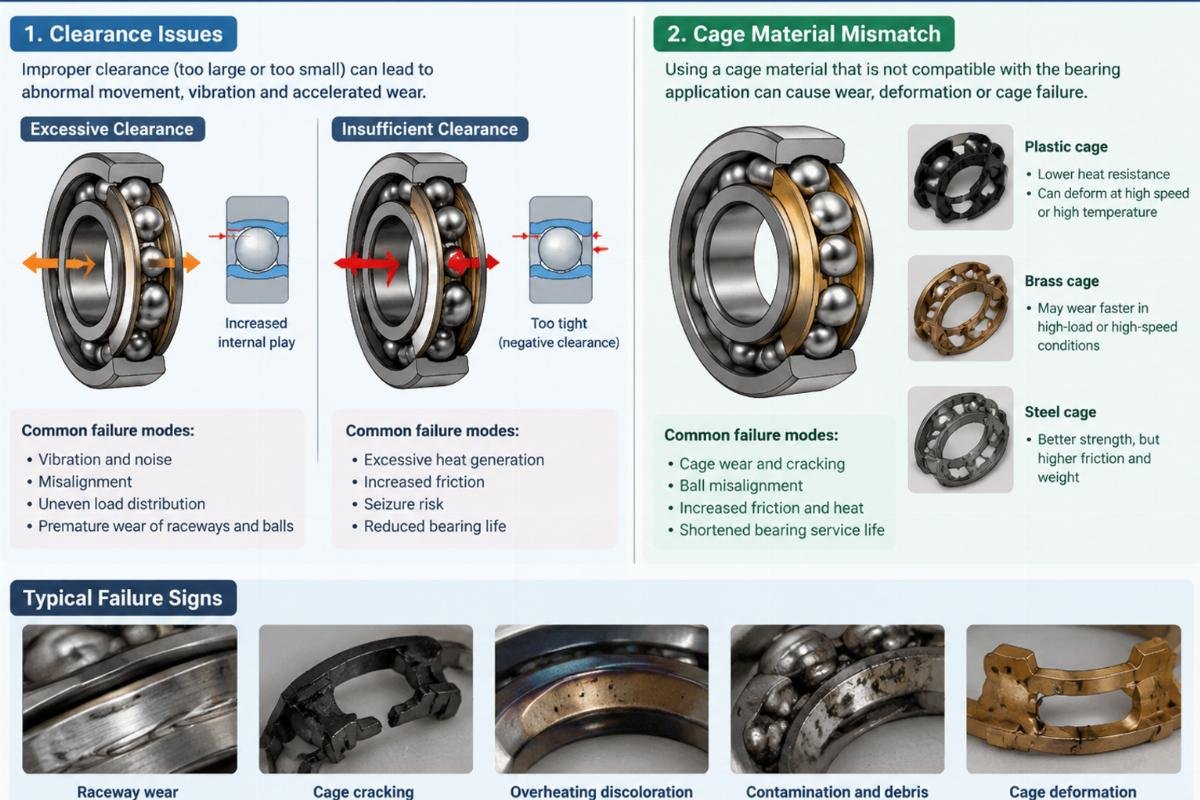
Technical verification should include a review of the lubricant and cage material specifications when switching brands. This step is often skipped in urgent MRO scenarios but is critical for long-term reliability.
Conclusion
Precision extends beyond the caliper.
Selecting the correct 6009 bearing requires matching internal clearance, seal type, and cage material to the specific operating conditions. Relying solely on external dimensions invites operational risks. Verified 6009 bearing dimensions equivalents ensure compatibility while optimizing performance and longevity.
Share this article

Written by
author
Editor covering global sourcing, supplier verification, and industrial product knowledge. Content is compiled from manufacturer specifications, industry standards, and hands-on experience with international B2B buyers. Every article is fact-checked before publishing to help procurement professionals make informed decisions.
More articles by author

