Auto Parts Wholesaler Container Program: Bulk Bearing Supplier
Strategic bearing container consolidation prevents transit damage and customs delays for auto parts wholesaler bearing supply chains. Implement load isolation and granular documentation to ensure mixed-brand shipments arrive in sellable condition, eliminating hidden costs from humidity exposure and prolonged inspections.
-
By author
- Updated
- 6 min read

Auto Parts Wholesaler Container Program: Bulk Bearing Supplier
Standard cartons are not enough for mixed-brand shipments.
Strategic container consolidation and precise mixed-brand packing prevent transit damage and customs delays for auto parts wholesalers by enforcing load isolation and granular documentation. This approach ensures that bearings from different manufacturers arrive in sellable condition, regardless of humidity or port inspection rigor.
I still remember the smell of rusted steel and damp cardboard in Jebel Ali. It was my first major shipment as a buyer, a twenty-foot container packed with SKF and NSK bearings for a regional distributor. The plan seemed simple: maximize space by mixing brands and sizes. The reality was a collapsed stack of bottom-tier cartons, their structural integrity destroyed by the weight above and the relentless Middle Eastern humidity. The防锈 paper had failed, and the bearings were compromised before they even cleared customs. Worse, the mixed packing list was vague, triggering a weeks-long hold by customs officers who could not verify the contents against the declaration. That loss was not just financial; it was a lesson in physics and bureaucracy. Now, when I design a bearing container consolidation program, I do not guess. I calculate load distribution, specify moisture barriers, and align every sub-list with customs requirements. [NEED_CITE: impact of humidity on bearing packaging integrity]
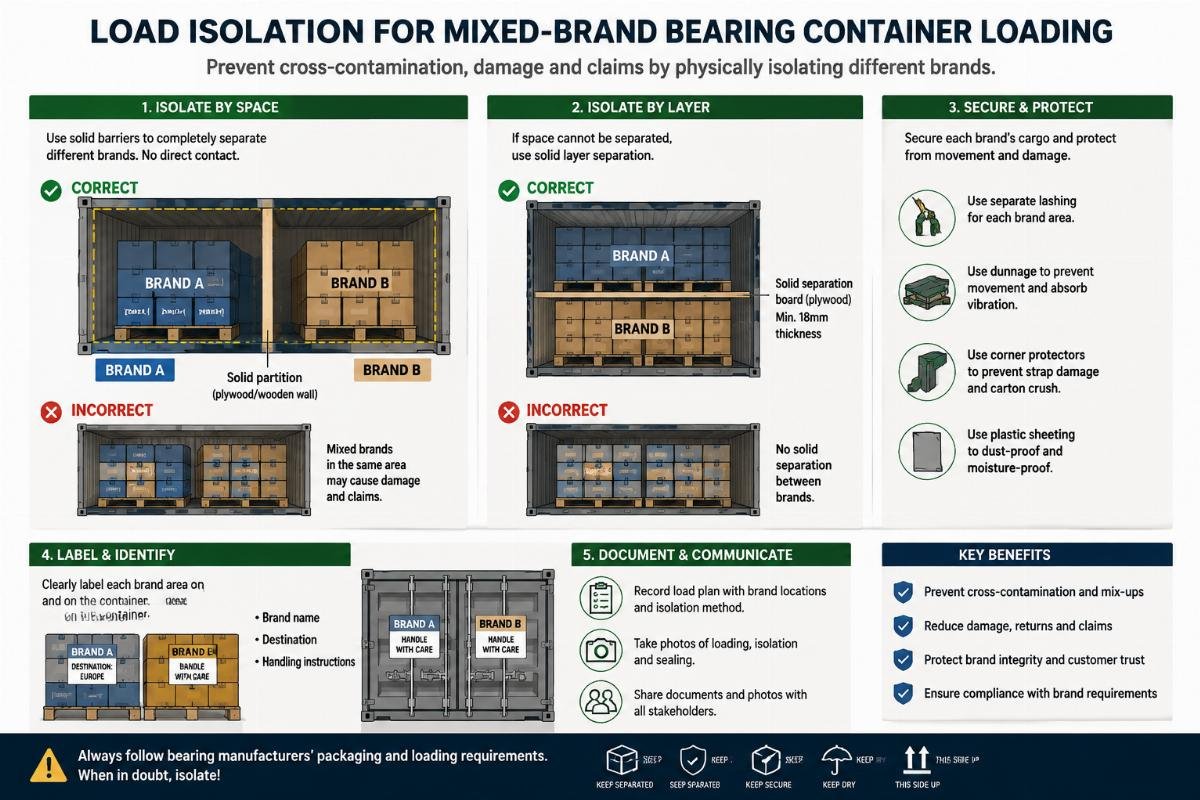
The difference between a profitable quarter and a logistical nightmare often lies in how you handle the empty space and the paperwork. For an auto parts wholesaler bearing supply chain, efficiency is not just about speed; it is about predictability.
Why Do Mixed-Bearing Shipments Fail in Transit?
Poor load isolation causes structural collapse in harsh climates.
Most buyers assume that standard manufacturer cartons are sufficient for ocean freight. They are not. When you mix brands like FAG, INA, and TIMKEN in a single container, you are mixing different carton dimensions, wall strengths, and stacking limits. Without a strategic plan, the heavier boxes crush the lighter ones, especially when humidity weakens the cardboard fibers. [NEED_CITE: correlation between humidity exposure and cardboard compressive strength]
In a recent case for a client in Southeast Asia, we analyzed a shipment where nearly half of the bottom-layer cartons were damaged. The issue was not the quality of the bearings but the lack of load-bearing isolation. The supplier had stacked heavy tapered roller bearing boxes directly on top of lighter deep-groove ball bearing cartons. In a dry warehouse, this might have held. In a humid port environment, the cardboard softened, and the stack shifted during rolling.
To prevent this, we implement size-based segregation. We group bearings by outer diameter and weight class, not just by brand. This allows us to create uniform layers that distribute weight evenly. We also use moisture-resistant wrapping for the entire palletized unit, not just individual boxes. This barrier protects against condensation that forms inside containers during temperature fluctuations at sea.
| Packing Factor | Standard Approach | Optimized Consolidation |
|---|---|---|
| Load Distribution | Random stacking by brand | Segregated by weight and size |
| Moisture Protection | Individual box wrapping | Full pallet shrink-wrap with desiccants |
| Carton Integrity | Vulnerable to humidity | Robust with reinforced layering |
| Damage Risk | High in mixed loads | Noticeably reduced |
This method ensures that even in a mixed brand bearing container loading scenario, the structural integrity of the package remains intact from the factory floor to the wholesaler’s warehouse.
How Does Inaccurate Documentation Trigger Customs Delays?
Undefined mixed packing lists lead to prolonged inspections.
Space saving is a valid goal, but it becomes a liability if the paperwork does not match the physical cargo. Customs authorities in many regions, particularly in the Middle East and Latin America, require detailed declarations for mixed shipments. A generic description like “auto parts” or even “bearings” is insufficient when multiple brands and types are involved. [NEED_CITE: customs clearance guidelines for mixed industrial goods]
A European buyer once faced demurrage costs that exceeded the value of the savings from consolidation. The issue was a packing list that grouped all bearings under a single HS code without specifying brands or types. Customs officers, unable to verify the contents quickly, ordered a full physical inspection. This process took days, during which the container sat in the heat, further risking the product.
We solve this by creating granular sub-lists. Each brand and type is listed separately, with corresponding part numbers and quantities. This matrix matches the physical layout of the container. If customs asks for verification of the NSK spherical roller bearings, we can point to the exact pallet and box range. This transparency accelerates clearance and avoids penalties.
For an auto parts wholesaler bearing supply operation, this level of detail is not optional. It is a requirement for smooth logistics. Our documentation process ensures that every item in the bearing container consolidation is traceable and verifiable, reducing the risk of holds to a minimum.

What is the Optimal Container Consolidation Strategy?
Size-based segregation and moisture-proofing ensure safe delivery.
Optimization is not just about filling the container; it is about protecting the cargo within it. The optimal strategy combines physical protection with logical organization. We start by calculating the load distribution. Heavy items like large spherical roller bearings go on the bottom, while lighter items like needle bearings go on top. But we do not just stack them; we isolate them.
We use dunnage and void fillers to prevent shifting during transit. This is critical for mixed brand bearing container loading, where different box sizes can create unstable gaps. By filling these gaps, we ensure that the cargo moves as a single unit, reducing the risk of internal collision.
Moisture control is equally important. We place desiccants strategically throughout the container, not just at the entrance. We also use vapor barrier bags for sensitive items. This comprehensive approach protects the bearings from salt air and humidity, which are common causes of corrosion during long sea voyages. [NEED_CITE: industry logistics reports on maritime corrosion risks]
Our experience shows that this method reduces damage rates significantly. Clients who switched to this optimized consolidation strategy reported fewer claims and higher customer satisfaction. The bearings arrive in pristine condition, ready for immediate resale or installation.

How to Align Packing Lists with Customs Requirements?
Granular sub-lists accelerate clearance and avoid penalties.
Alignment between physical cargo and documentation is the key to fast clearance. We do not just provide a packing list; we provide a map. Each item is linked to its physical location in the container. This allows customs officers to verify specific items without unpacking the entire shipment.
We also ensure that the HS codes are accurate for each type of bearing. Misclassification is a common cause of delays and fines. By using precise descriptions and correct codes, we minimize the risk of disputes. This is particularly important for mixed-brand shipments, where different brands may have slightly different specifications.
Our documentation service includes a review process. We check every line item against the commercial invoice and the bill of lading. This triple-check system ensures consistency and accuracy. For an auto parts wholesaler bearing supply business, this attention to detail is a competitive advantage. It builds trust with customs authorities and reduces the time goods spend in port.
This level of precision transforms bearing packing for Middle East and other challenging markets from a gamble into a predictable process. Clients can plan their inventory and sales with confidence, knowing that their goods will arrive on time and in perfect condition.

Conclusion
Predictability is the ultimate luxury in global logistics.
Strategic container consolidation and precise documentation are not just operational details; they are essential safeguards for your business. By focusing on load isolation, moisture protection, and granular paperwork, you can eliminate the hidden costs of damage and delays. This approach ensures that your mixed-brand bearing shipments arrive ready for sale, preserving your margin and your reputation.
Tags
Share this article

Written by
author
Editor covering global sourcing, supplier verification, and industrial product knowledge. Content is compiled from manufacturer specifications, industry standards, and hands-on experience with international B2B buyers. Every article is fact-checked before publishing to help procurement professionals make informed decisions.
More articles by author

