Documentary Collection D/P D/A Bearing Imports Wholesale Supplier
Master Documentary Collection for Bearing Imports by choosing D/P over risky D/A terms to secure payment before cargo release. Banks act only as document forwarders under URC 522, offering no payment guarantees. Protect your supply chain with proven strategies for smooth clearance and minimized default risks in global bearing trade.
-
By author
- Updated
- 8 min read
Documentary Collection D/P D/A Bearing Imports Wholesale Supplier
Banks do not guarantee payment in documentary collection. This is the single most dangerous misconception for importers of industrial components. When you choose documentary collection, you are relying on the buyer’s willingness to pay, not the bank’s obligation to cover your funds. The bank acts merely as a postman, forwarding documents against payment or acceptance, with no liability if the buyer refuses the goods. For high-value bearing shipments, this distinction determines whether you receive full payment or face a costly dispute over stranded cargo.
Understanding the mechanics of Documentary Collection for Bearing Imports is essential for securing your supply chain. While it offers a middle ground between the security of Letters of Credit and the risk of Open Account trading, the specific terms you select dictate your exposure. I have seen too many distributors lose leverage by accepting the wrong conditions, only to find their bearings sitting in a foreign port while negotiations drag on. The choice between Documents against Payment (D/P) and Documents against Acceptance (D/A) is not just administrative; it is a strategic decision that defines your risk profile.
What is the core difference between D/P and D/A in bearing trade?
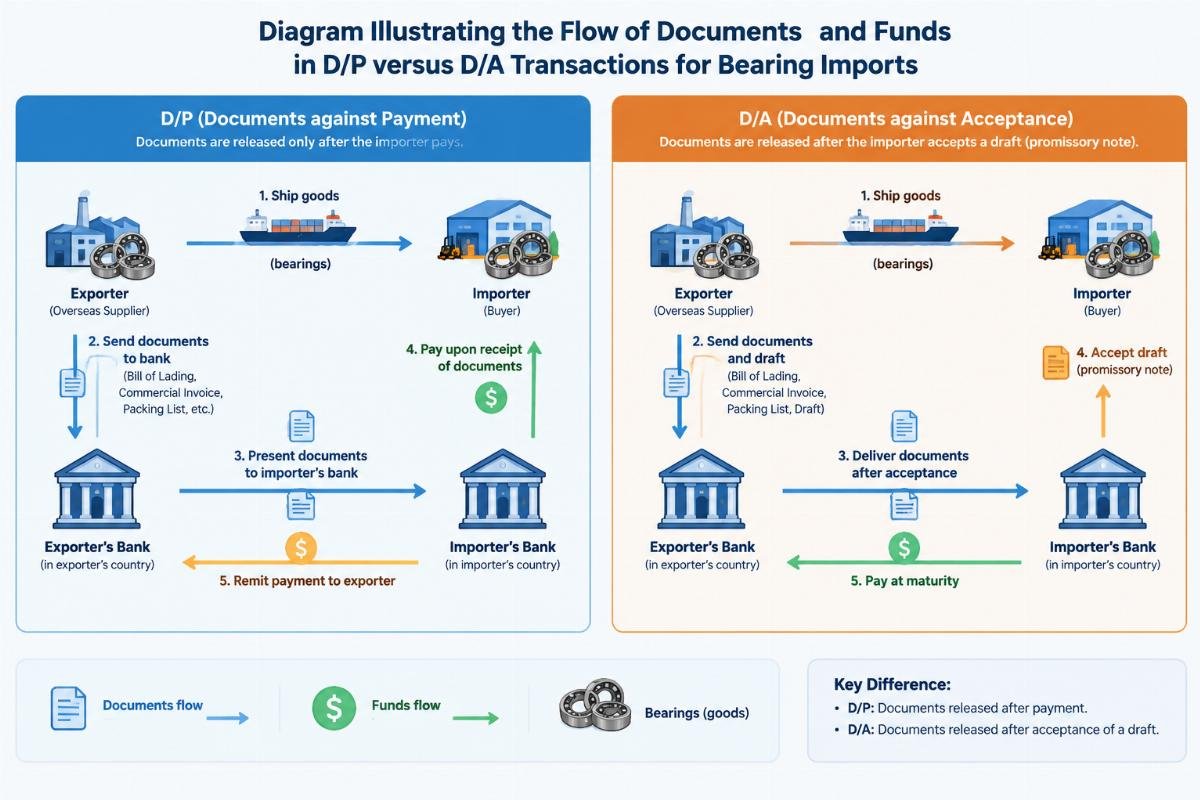
D/P requires immediate payment before document release, whereas D/A relies on the buyer’s promise to pay at a future date. This fundamental difference changes who holds the leverage during the transaction. In a D/P scenario, the collecting bank will not hand over the bill of lading and other title documents until the importer settles the invoice. Until that moment, the exporter retains control over the cargo. In contrast, D/A allows the buyer to take possession of the goods by simply signing a time draft, promising to pay weeks or months later.
The risk disparity is stark. With D/P, if the buyer fails to pay, the seller still owns the goods and can attempt to resell them, albeit with additional shipping and storage costs. With D/A, the buyer has already taken physical possession. If they default, the seller is left with an unsecured debt claim and no collateral. [NEED_CITE: ICC Uniform Rules for Collections URC 522 article on release of documents]
Consider a recent case involving a distributor in Latin America. They requested D/A terms for a container of mixed-brand bearings, citing cash flow constraints. Trusting the long-standing relationship, the supplier agreed. The goods were cleared and installed in local machinery within days. However, when the maturity date arrived, the buyer cited minor packaging discrepancies to withhold thirty percent of the payment. Since the goods were already in use, the supplier had no leverage to negotiate and accepted a significant loss to close the file. This scenario highlights why D/P is often the safer route for new or volatile markets.

For Documentary Collection for Bearing Imports, the D/P term ensures that the financial transaction is completed before the legal title transfers. It aligns the incentive of the buyer to pay promptly to secure their inventory. While D/A may seem like a gesture of trust, it effectively converts a trade transaction into an unsecured loan, exposing the supplier to credit risk without the protection of a bank guarantee.
Why is D/P strongly recommended over D/A for new bearing suppliers?
D/A exposes sellers to high default risks without bank guarantees, making D/P the prudent choice for establishing new trade relationships. Many buyers argue that D/A builds trust and facilitates smoother long-term cooperation. However, from a risk management perspective, it shifts all the burden onto the supplier. Banks involved in documentary collection do not verify the buyer’s creditworthiness or guarantee payment. Their role is strictly limited to handling documents according to the instructions provided. [NEED_CITE: Role of banks in documentary collection under URC 522]
When dealing with new partners, especially in regions with fluctuating currency stability or complex legal frameworks for debt recovery, D/P provides a critical safety net. It ensures that the buyer has the funds available and is willing to release them before taking control of the high-value assets. Bearings, being standardized industrial components, can sometimes be subject to market price fluctuations. A buyer facing a drop in local demand might be tempted to reject goods under D/A terms, leaving the supplier with stranded inventory. Under D/P, such rejection is less likely because the buyer must pay to access the goods.
A Middle East wholesaler recently imported a mixed container of spherical roller and deep-groove ball bearings using D/P terms. The process was seamless. The buyer prepared the funds in advance, knowing that the documents would only be released upon payment. Clearance was completed within days, and the goods moved quickly to their distribution center. There was no ambiguity about ownership or payment timing. This smooth transaction stands in contrast to the uncertainties often associated with D/A, where payment delays can tie up capital for months.

For suppliers offering Documentary Collection for Bearing Imports, insisting on D/P for initial orders or new clients is a standard risk mitigation strategy. It filters out buyers who are not financially prepared and establishes a discipline of prompt payment. Once a reliable payment history is established, terms can be renegotiated, but starting with D/P protects both parties from early-stage misunderstandings and financial strain.
How do banks handle documents under URC 522 for bearing shipments?
Banks act only as document forwarders, not credit insurers, adhering strictly to the Uniform Rules for Collections (URC 522). This rule set, published by the International Chamber of Commerce, governs how banks process documentary collections. It explicitly states that banks assume no liability for the form, sufficiency, accuracy, genuineness, falsification, or legal effect of any document. [NEED_CITE: URC 522 Article 4 disclaimer on documents]
In the context of bearing imports, this means the bank will check that the documents listed in the collection instruction are present. They will not verify if the bearings inside the container match the specifications on the commercial invoice or if the quality meets the buyer’s expectations. If the buyer refuses the documents due to a perceived quality issue, the bank will not intervene in the commercial dispute. They will simply notify the seller and hold the documents or return them, depending on the instructions.
This limitation places the onus on the seller to ensure document accuracy and on the buyer to perform due diligence before shipment. For example, if a certificate of origin is missing or incorrectly dated, the bank may refuse to process the collection, causing delays. Similarly, if the bill of lading contains errors, customs clearance in the destination country may be halted, leading to demurrage charges.
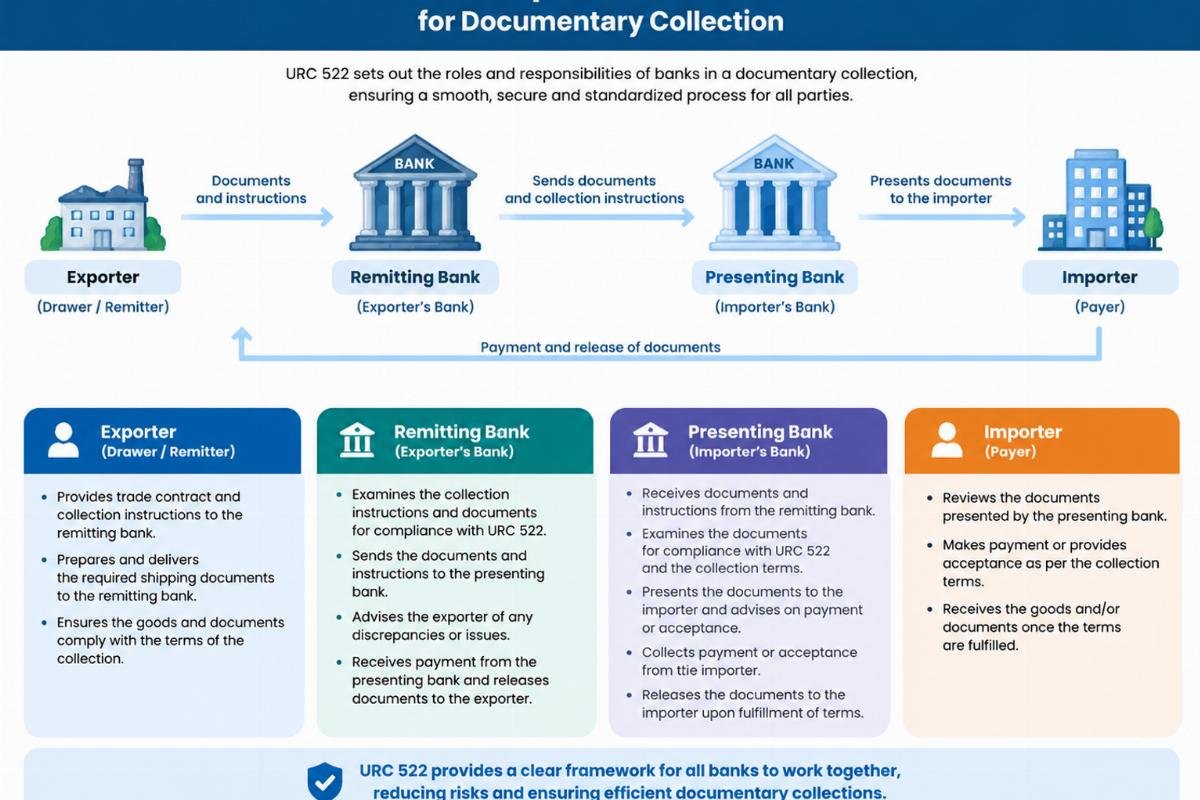
Understanding that banks do not guarantee performance is crucial for anyone engaging in Documentary Collection for Bearing Imports. Sellers must ensure their documentation is flawless to avoid technical rejections. Buyers must be confident in the supplier’s quality control, as they cannot rely on the bank to validate the goods. This shared responsibility underscores the importance of clear communication and precise documentation in every transaction.
What steps should buyers take to ensure smooth D/P clearance for mixed containers?
Prepare funds in advance and verify document compliance to prevent delays in D/P transactions. Since D/P requires payment before document release, any delay in fund availability or document discrepancy can halt the entire process. For buyers importing mixed-brand bearings, this preparation is even more critical due to the complexity of the paperwork involved.
First, confirm the exact list of required documents with the supplier before shipment. This typically includes the commercial invoice, packing list, bill of lading, certificate of origin, and any specific quality certificates required by local customs. Ensure that the details on these documents, such as weight, volume, and product descriptions, match exactly. Discrepancies, even minor ones, can lead to rejection by the collecting bank or customs authorities.
Second, arrange for the payment funds to be available in your account before the documents arrive at the collecting bank. D/P transactions often move quickly, and delays in transferring funds can result in storage fees at the port. For urgent MRO orders, where downtime costs are high, this speed is essential. A recent case involved an emergency order for tapered roller bearings for a mining operation. The buyer used D/P terms, ensuring that once the payment was made, the documents were released immediately. This allowed for rapid clearance and minimized production downtime, saving significant operational costs.
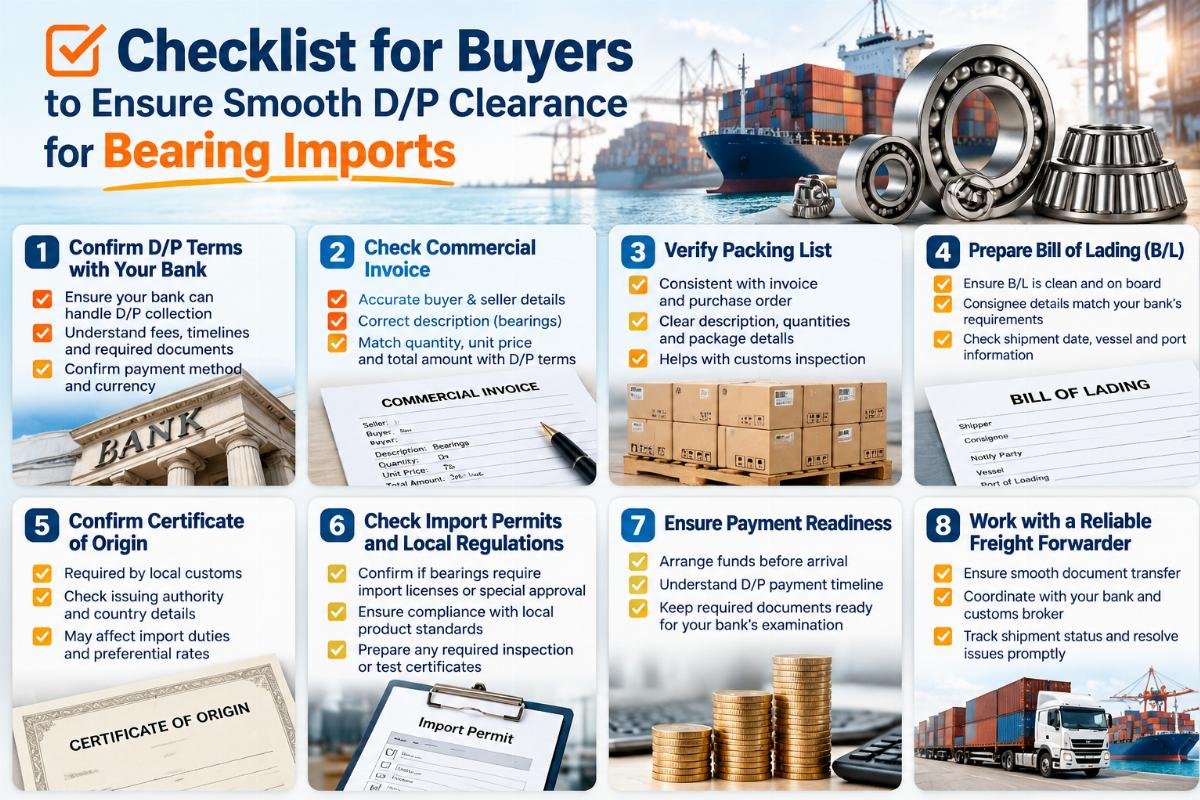
Finally, work with a freight forwarder who understands the nuances of documentary collection. They can help monitor the status of the documents and coordinate with the bank to ensure swift release upon payment. For suppliers providing one-stop mixed-brand bearing consolidation, having complete and accurate customs documentation is part of the service. This ensures that the D/P process is not hindered by paperwork errors, allowing for fast clearance and efficient supply chain management. By following these steps, buyers can leverage the security of D/P while maintaining the efficiency needed for modern industrial operations.
Conclusion
D/P remains the safest documentary collection method for bearing imports, balancing security and efficiency. While D/A offers flexibility, it introduces unacceptable credit risks for suppliers and potential disputes for buyers. By adhering to D/P terms, understanding the limited role of banks under URC 522, and preparing documentation meticulously, both parties can ensure smooth and secure transactions. For those navigating Documentary Collection for Bearing Imports, prioritizing payment security through D/P is the most reliable path to sustainable trade relationships.
Share this article

Written by
author
Editor covering global sourcing, supplier verification, and industrial product knowledge. Content is compiled from manufacturer specifications, industry standards, and hands-on experience with international B2B buyers. Every article is fact-checked before publishing to help procurement professionals make informed decisions.
More articles by author

