Genuine Bearing Supply Contracts: Wholesale Supplier for Bulk & MRO Orders
Draft precise tender documents for bearing supply contracts to prevent costly field failures from vague equivalent quality clauses. Mandate original mill certificates, define strict substitution approval workflows, and set clear inspection standards. Ensure genuine traceability and minimize downtime risks in your MRO procurement agreements.
-
By author
- Updated
- 7 min read

Genuine Bearing Supply Contracts: Wholesale Supplier for Bulk & MRO Orders
Vague “equivalent quality” clauses do not save money; they multiply downtime costs.
To draft effective tender documents for bearing supply contracts, you must explicitly define authenticity verification, mandate original mill certificates over commercial invoices, and establish clear substitution approval workflows. Without these specific clauses, buyers face high risks of receiving counterfeit or substandard parts, leading to catastrophic field failures and prolonged legal disputes. This guide details the essential components of robust procurement agreements for industrial bearings.

I learned this the hard way in a dusty workshop in Suzhou before moving into international trade. Early in my career, I handled an urgent MRO order for a mining client in West Africa. The contract simply stated “Tier-1 brand equivalent quality.” To cut costs and meet the tight deadline, I sourced domestic alternatives that matched the dimensional specs. The client installed them immediately. Within days, the crushers seized. The client demanded a full refund, citing the lack of stamped origin certificates. The container sat at customs for weeks while we argued over paperwork that should have been specified upfront. That experience reshaped how I view every line item in a procurement agreement. It is not about trust; it is about verifiable data. [NEED_CITE: common causes of bearing failure in mining applications]
Why Do Vague “Equivalent Quality” Clauses Cause Disputes?
Ambiguous substitution terms are the primary driver of rejected batches and operational downtime.
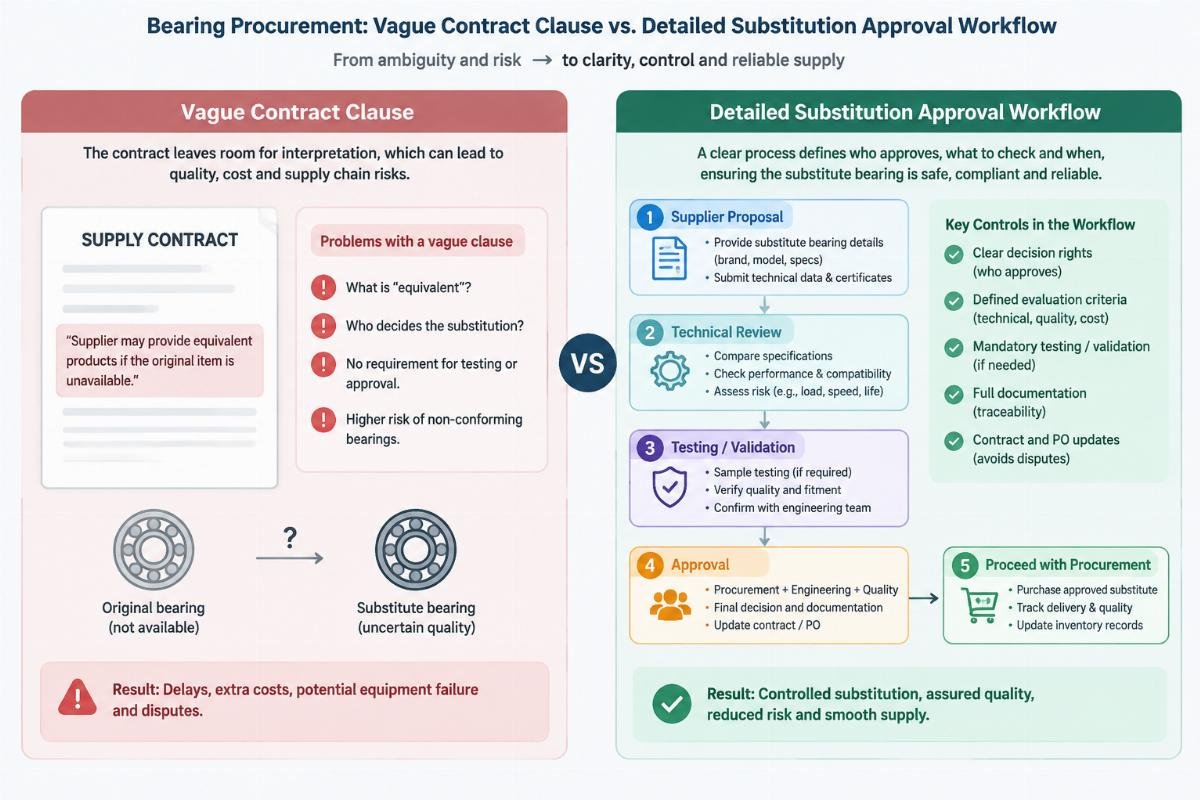
When a tender document allows for “equivalent” brands without defining the approval process, it opens the door to interpretation gaps. Suppliers may offer products that meet basic dimensional standards but fail in material purity or heat treatment consistency. For heavy-industry operators, this distinction is critical. A bearing might fit the shaft but fail under load due to inferior steel cleanliness.
Consider a case involving a mixed-brand consolidation order for a large-scale infrastructure project. The buyer accepted a substitution for a specific spherical roller bearing, assuming the alternative offered similar performance. However, the substitute lacked the specific cage design required for high-speed stability in their application. The result was a significant percentage of rejected SKUs across the total mixed order, forcing a complete re-evaluation of the supply chain.
| Clause Type | Risk Level | Verification Method | Outcome |
|---|---|---|---|
| “Equivalent Quality” | High | Visual Inspection | Frequent Field Failures |
| “Approved Vendor List” | Medium | Certificate Check | Moderate Disputes |
| “Specific Brand/Part No.” | Low | Full Traceability | Minimal Issues |
To avoid this, tender documents for bearing supply contracts must require pre-approval for any substitution. This means the supplier must submit technical datasheets and material certifications for the proposed alternative before shipment. The buyer’s engineering team then validates these against the original equipment manufacturer’s specifications. This step adds time to the procurement phase but saves months of claim negotiations later. [NEED_CITE: impact of material purity on bearing fatigue life]
What Traceability Documents Must Be Stipulated in the Tender?
Require original mill certificates and stamped authorization letters, not just commercial invoices.
Many buyers accept commercial invoices as proof of origin. This is a critical error. A commercial invoice only proves a transaction occurred; it does not prove the physical goods match the description. For genuine bearing traceability requirements, the tender must specify that each batch comes with a factory certificate of analysis (COA) or mill test report. These documents link the specific batch number on the bearing packaging to the production records of the manufacturer.
In one instance, an urgent spare parts order for a marine vessel was held at customs because the traceability documents were unstamped copies. The port authorities could not verify the authenticity of the high-value tapered roller bearings. The delay forced the vessel to remain idle, costing far more than the price of the bearings themselves. The issue was not the quality of the product, but the inadequacy of the paperwork stipulated in the tender.
Essential documents to list in your tender include:
- Original Manufacturer’s Certificate of Conformity.
- Stamped Authorization Letter from the brand owner (if sourcing via a distributor).
- Batch-specific Heat Treatment Records.
- Packing List matching individual box serial numbers.
These requirements ensure that every unit can be traced back to its source. If a supplier cannot provide these, they are likely trading in gray market or counterfeit goods. Integrating these demands into tender documents for bearing supply contracts filters out non-compliant vendors early in the bidding process. [NEED_CITE: ISO standards for bearing documentation and traceability]
How to Define Inspection Standards for Mixed-Brand Containers?
Specify pre-shipment verification and third-party inspection protocols for consolidated shipments.
Consolidating multiple brands like SKF, FAG, NSK, and TIMKEN into a single container is cost-effective but introduces complexity. Different brands have different packaging standards and marking systems. Without clear inspection criteria, it is difficult to verify the condition of goods upon arrival. Damaged packaging can lead to contamination, which is fatal for precision bearings.
The tender must define the Acceptable Quality Limit (AQL) for incoming inspections. For example, specify that zero tolerance applies to rust, dents, or broken seals. Additionally, require that the supplier performs a pre-shipment inspection and provides a detailed report with photos. This report should cover random sampling from each brand lot within the mixed container.
A European wind farm operator once received a mixed container where the inner packaging for several angular contact ball bearings was compromised. Because the tender did not specify moisture barrier requirements for sea freight, the bearings arrived with surface corrosion. The entire lot had to be scrapped. Had the tender included specific packing standards for ocean freight, this loss would have been preventable.
Key inspection points to include:
- Integrity of original sealed packaging.
- Verification of part numbers against the packing list.
- Visual check for rust or physical damage.
- Random dimension checks for critical tolerances.
By setting these standards in tender documents for bearing supply contracts, buyers ensure that the consolidation process does not compromise product integrity. It shifts the responsibility of quality assurance to the supplier before the goods leave the warehouse. [NEED_CITE: AQL sampling methods for industrial components]

How to Handle Emergency MRO Orders Within Formal Tenders?
Build flexible MOQ and fast-track documentation clauses for urgent breakdown replacements.
Standard tender processes are often too slow for emergency maintenance scenarios. When a critical machine fails, waiting for a full bureaucratic approval cycle is not an option. However, bypassing procedures entirely leads to the risks mentioned earlier. The solution is to embed a fast-track mechanism within the main agreement.
This clause should allow for pre-approved emergency orders up to a certain value or quantity without re-tendering. It must also specify that even for urgent orders, digital copies of traceability documents must accompany the shipment notification. Physical originals can follow, but the digital trail ensures customs clearance and internal acceptance can proceed immediately.
Consider a cement plant that faced a sudden failure in its kiln drive. They needed specific cylindrical roller bearings within 48 hours. Because their master tender included an emergency clause with pre-vetted suppliers who held spot inventory, they could place an order instantly. The supplier shipped from local stock, and the digital certificates allowed the plant to accept the goods without delay. This flexibility minimized unplanned production downtime significantly.
Elements of an effective emergency clause:
- Pre-agreed pricing formulas for rush orders.
- List of approved suppliers with verified local stock.
- Requirement for immediate digital documentation transfer.
- Simplified acceptance protocol for critical spares.
Integrating these provisions into tender documents for bearing supply contracts balances the need for speed with the necessity of compliance. It ensures that urgency does not become an excuse for poor procurement practices. [NEED_CITE: best practices for MRO spare parts management]

Conclusion
Clear clauses prevent costly failures.
Drafting precise tender documents for bearing supply contracts is not merely an administrative task; it is a strategic defense against supply chain risks. By defining traceability, substitution rules, and inspection standards, buyers protect their operations from the hidden costs of counterfeit or substandard parts. Experience shows that the time invested in detailing these requirements pays dividends in reliability and peace of mind.
Tags
Share this article

Written by
author
Editor covering global sourcing, supplier verification, and industrial product knowledge. Content is compiled from manufacturer specifications, industry standards, and hands-on experience with international B2B buyers. Every article is fact-checked before publishing to help procurement professionals make informed decisions.
More articles by author

