Heavy Bearing Load Limits: Wholesale Supplier for Bulk Orders
Master Container Weight Limits for Heavy Bearing Loads to avoid port rejections and transit damage. Balance dynamic load ratings with actual impact conditions to prevent premature cage fractures. Optimize mixed-bearing consolidation with verified traceability for seamless customs clearance and operational reliability.
-
By author
- Updated
- 6 min read
Heavy Bearing Load Limits: Wholesale Supplier for Bulk Orders
Bigger bearings are not always stronger.
Shipping heavy bearings requires balancing container weight limits with actual load calculations. Oversized bearings failing under dynamic loads cause downtime, making precise specification matching critical for safe transit and operational reliability.
I still remember the silence in a North African mining site after a conveyor line stopped. The client had ordered large spherical roller bearings, focusing strictly on dimensions and unit price while ignoring static load limits. When the equipment faced heavy impact loads, the cage fractured immediately. The resulting downtime penalty cost several times the savings from the cheaper procurement. That incident reshaped how I approach every inquiry. Now, before discussing quantities, I ask about the operating conditions and actual loads. Heavy bearings are not just about size; if the limit load is miscalculated, even a full container of stock becomes scrap metal. [NEED_CITE: common failure modes in heavy-duty bearing applications per ISO 15243]
Understanding these constraints is essential for global distributors and MRO buyers. This guide explains how to navigate Container Weight Limits for Heavy Bearing Loads, ensuring your shipments arrive intact and your machinery runs smoothly.
What Are the Real Weight Limits for Bearing Containers?
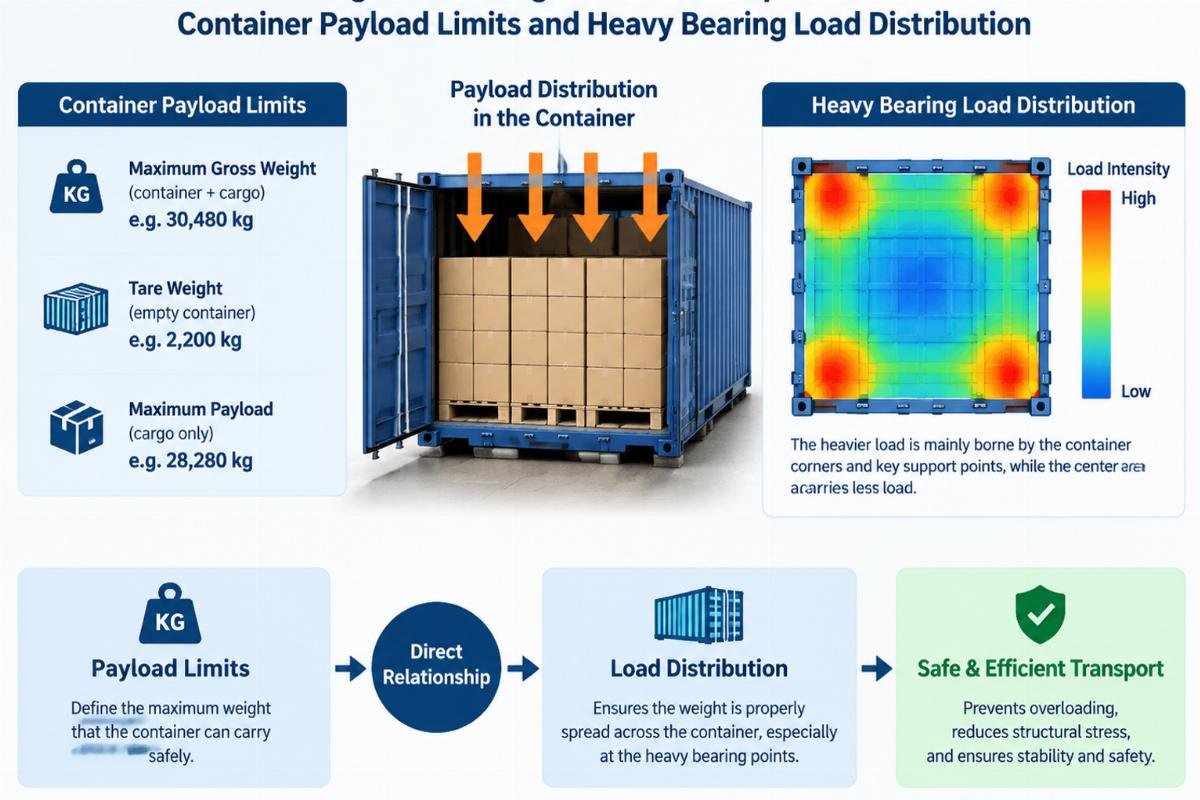
Payload capacity depends on container specifications and route restrictions, not just the gross weight rating.
Many buyers assume that a 20-foot or 40-foot container can be filled to its maximum gross weight without issue. However, maritime regulations and port infrastructure impose strict limits on payload. A standard 20-foot container has a tare weight of approximately two tons, leaving a payload capacity of around twenty-eight tons. But this is the theoretical maximum. In practice, road transport limits at the origin and destination ports often restrict the total truck weight to much lower levels. [NEED_CITE: international maritime container weight regulations and port infrastructure limits]
When shipping heavy machinery bearings, such as large spherical roller bearings or tapered roller bearings, the density of the cargo is high. A single pallet of large-diameter bearings can weigh several tons. If you maximize the container payload with mixed heavy bearings, you risk hitting port weight limits upon arrival. An African distributor once faced near-rejection at the port because his consolidated shipment exceeded the local road transport axle load limits. He had to pay for costly deconsolidation and re-routing.
To avoid this, calculate the net payload by subtracting the container tare weight from the maximum gross weight, then apply a safety margin for port restrictions. For heavy bearing loads, it is often more efficient to use multiple containers with balanced weight distribution rather than maximizing a single unit. This approach also simplifies handling at the final destination, where heavy-lift equipment may be limited.

How Do You Calculate Load Limits for Heavy Bearings?
Match dynamic load ratings to actual impact conditions, not just static weight.
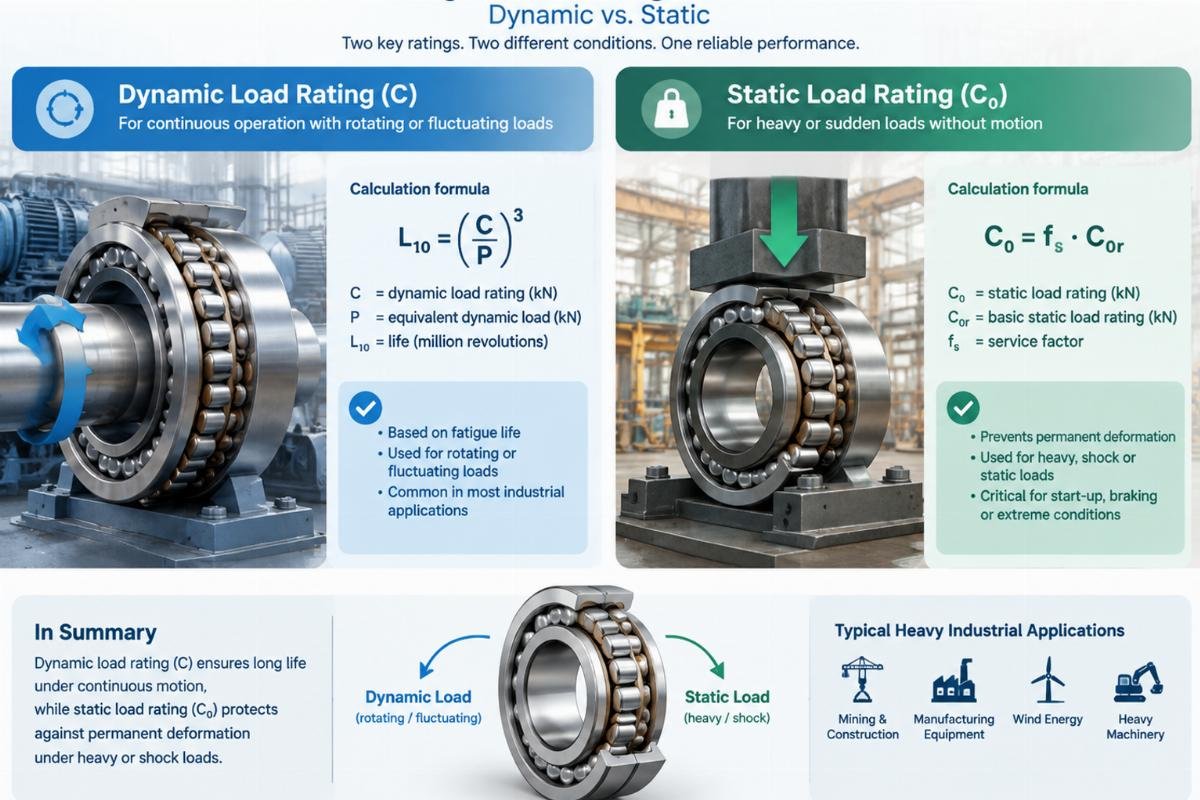
Calculating the right bearing for a heavy-duty application involves more than checking the catalog diameter. The core argument is that shipping heavy bearings requires balancing container weight limits with actual load calculations. Buyers must distinguish between static load rating (C0) and dynamic load rating (C). Static rating applies to stationary or slowly rotating loads, while dynamic rating predicts fatigue life under rotation. [NEED_CITE: ISO bearing load standards for dynamic and static load ratings]
For mining crushers or steel mill rollers, the loads are not constant. They involve shock and impact. Using a standard impact factor multiplier is crucial. If you ignore these dynamic factors, the bearing may appear sufficient on paper but fail prematurely in operation. A European wind farm operator once replaced standard bearings with oversized ones, assuming bigger meant stronger. However, the new bearings had different internal clearances and did not align with the housing tolerances. This misalignment caused premature wear and a high warranty claim ratio.
When selecting bearings for bulk orders, verify the dynamic load rating against the actual operating conditions. Consider the speed, temperature, and lubrication regime. Our technical selection support helps clients cross-reference equivalent models from brands like SKF, FAG, TIMKEN, and NSK to ensure the chosen specification matches the real-world stress profile. This prevents the common mistake of over-specifying size while under-specifying performance.
Why Do Oversized Bearings Fail in Heavy-Duty Applications?
Ignoring actual operating conditions leads to structural fractures, regardless of size.
A counter-intuitive view in the industry is that bigger bearings are not always stronger. Incorrect dynamic load ratings cause faster failure if the bearing is not suited for the specific application. Oversizing can lead to issues with fit, clearance, and heat generation. If an oversized bearing is forced into a housing designed for a smaller unit, the internal geometry changes. This can reduce the effective contact area of the rolling elements, increasing stress concentration.
In one case, an OEM replacement project chose oversized spherical roller bearings for a heavy excavator. The assumption was that the larger size would handle the heavy bearing load limits better. However, the increased mass added inertia, and the mismatched clearance led to uneven load distribution. Under heavy impact, the cage suffered from excessive friction and eventually fractured. This failure mode is common when buyers focus solely on physical dimensions rather than engineering specifications. [NEED_CITE: industry association guidelines on bearing selection and housing fit]
To prevent this, always consult technical datasheets and consider the entire system dynamics. Our team provides cross-brand equivalent model consultation to ensure that any substitution maintains the required precision and load capacity. We verify that the selected bearings from our spot inventory meet the original equipment manufacturer’s specifications, avoiding the risks associated with arbitrary upsizing.

How to Optimize Mixed-Bearing Container Loading?
Balance weight distribution and verify traceability docs for compliance.
Optimizing a mixed-bearing container requires careful planning. Global distributors often need to consolidate various types, such as deep-groove ball bearings, cylindrical roller bearings, and thrust bearings, into a single shipment. The challenge is to maximize space utilization without exceeding weight limits or causing damage during transit. Heavy items should be placed at the bottom to lower the center of gravity, while lighter, precision bearings can be stacked above. [NEED_CITE: best practices for securing heavy cargo in maritime containers]
Traceability is equally important. Each brand, whether it is INA, NTN, KOYO, or domestic lines like ZWZ and HRB, must have complete documentation. Customs authorities in many regions require proof of origin and authenticity for industrial components. Missing papers can lead to delays or seizure. A US buyer once experienced significant delays because the traceability documents for a mixed batch were incomplete. By ensuring that every item in the consolidation has verifiable docs, you smooth the clearance process.
Our one-stop mixed-brand consolidation service handles this complexity. We inspect and verify the weight and documentation before dispatch. This ensures that your Container Weight Limits for Heavy Bearing Loads are respected, and your goods clear customs without issues. We balance the load physically and administratively, providing a seamless sourcing solution for bulk project orders.

Conclusion
Precise specification matching prevents costly failures and transit issues.
Shipping heavy bearings is not just about logistics; it is about engineering accuracy. By understanding Container Weight Limits for Heavy Bearing Loads, you avoid overloading containers and selecting inappropriate components. Focus on dynamic load ratings, respect port restrictions, and ensure full traceability. This approach minimizes downtime and protects your investment in heavy-duty machinery.
Tags
Share this article

Written by
author
Editor covering global sourcing, supplier verification, and industrial product knowledge. Content is compiled from manufacturer specifications, industry standards, and hands-on experience with international B2B buyers. Every article is fact-checked before publishing to help procurement professionals make informed decisions.
More articles by author

