UC206 Insert Bearing Dimensions & Uses – Wholesale Supplier
Master UC206 insert bearing dimensions and precise housing fits to prevent costly downtime in agricultural and conveyor systems. Learn how correct 30mm bore tolerances and self-aligning capabilities mitigate field failures caused by misalignment or improper installation for reliable industrial performance.
-
By author
- Updated
- 7 min read

UC206 Insert Bearing Dimensions & Uses – Wholesale Supplier
Looser housing fits do not prevent sticking; they cause micro-vibration and fretting corrosion.
The UC206 insert bearing features a 30mm bore, 62mm outer diameter, and 38.1mm width. Its self-aligning capability allows for angular misalignment up to two degrees, making it critical for agricultural machinery and conveyor systems where shaft deflection is common. Correct housing clearance between 0.05mm and 0.15mm prevents dust ingress while avoiding seal deformation.
I still remember the call at 2 AM from a processing plant manager. The main conveyor had seized, halting the entire production line. When we opened the housing, the UC206 insert bearing was welded to the shaft by friction heat. The root cause was not load or speed, but installation. The maintenance team had hammered the bearing into a housing that was machined too tight, cracking the inner ring. Another time, a harvester operator complained of constant vibration. The issue was excessive housing clearance, allowing the bearing outer ring to spin inside the seat. These field failures are rarely due to manufacturing defects. They stem from ignoring the precise dimensional relationship between the bearing, shaft, and housing. [NEED_CITE: common installation errors in insert bearings per ABMA standards]
Understanding these dimensions is not just about reading a catalog. It is about preventing costly downtime. For distributors and MRO managers, knowing the exact specs of a UC206 insert bearing ensures you supply the right component for the application.
What Are the Exact Dimensions of UC206?
The physical envelope of the UC206 defines its load capacity and compatibility with standard pillow block housings.
The UC206 is part of the standard inch-series insert bearing family. While the designation “206” suggests a specific size code, the actual metric dimensions are what matter for engineering fit. The bore diameter is 30mm. This is the most critical dimension, as it determines the shaft size. The outer diameter is 62mm, and the total width is 38.1mm. This width includes the inner ring extension on one side, which is typical for this series.
The weight of a single UC206 insert bearing is approximately 0.29 kg. This might seem trivial, but in high-speed applications, mass affects dynamic balance. The spherical outer diameter allows the bearing to align itself within the housing. This self-aligning feature compensates for minor shaft deflections or mounting errors. Without this spherical design, even slight misalignments would cause edge loading on the balls, leading to premature fatigue.
| Parameter | Value | Note |
|---|---|---|
| Bore Diameter | 30 mm | Standard shaft fit |
| Outer Diameter | 62 mm | Spherical surface for alignment |
| Total Width | 38.1 mm | Includes inner ring extension |
| Inner Ring Width | 19 mm | Approximate raceway width |
| Weight | ~0.29 kg | Single unit mass |
These dimensions are standardized across major manufacturers. Whether you source from SKF, FAG, or ZWZ, the envelope dimensions remain consistent to ensure interchangeability. However, internal clearances may vary. Most UC206 units come with C3 radial internal clearance as standard. This extra clearance accommodates thermal expansion during operation. [NEED_CITE: ISO 3290 dimensional tolerances for rolling bearings]

For buyers, verifying these dimensions against your existing equipment is the first step. A mismatch in width can prevent the bearing from seating correctly in the housing, leaving gaps for contaminants. A mismatch in bore leads to either a loose fit on the shaft or damage during press-fitting.
How Do UC206 Fits and Tolerances Work?
Shaft and housing fits dictate lifespan; wrong fits cause spin or crack.
The performance of a UC206 insert bearing relies heavily on the fit between its components. There are two critical interfaces: the inner ring to the shaft, and the outer ring to the housing.
The inner ring is typically secured to the shaft using set screws or eccentric locking collars. For a 30mm shaft, the bore tolerance should be h9 or h10. This allows for easy sliding during installation while maintaining sufficient contact area for torque transmission. If the shaft is worn or undersized, the set screws will dig into the metal, causing imbalance. If the shaft is oversized, forcing the bearing on will expand the inner ring, reducing the internal clearance and causing overheating.
The housing fit is where many errors occur. The housing bore should have a slight clearance relative to the bearing’s spherical outer diameter. A common mistake is machining the housing too tight. This prevents the bearing from self-aligning. The spherical surface needs room to pivot. Conversely, if the housing is too loose, the bearing will rotate under load. This rotation generates heat and wears out the housing seat, requiring expensive casting repairs.
| Fit Type | Condition | Consequence |
|---|---|---|
| Shaft Fit | Too Tight | Inner ring expansion, loss of clearance, overheating |
| Shaft Fit | Too Loose | Slippage, fretting corrosion, set screw failure |
| Housing Fit | Too Tight | Restricted self-alignment, edge loading |
| Housing Fit | Too Loose | Outer ring rotation, housing wear, vibration |
A European agricultural equipment manufacturer once faced repeated failures in their combine harvesters. The UC206 bearings were failing within weeks. Investigation revealed that the housing bores were machined to a tight tolerance, assuming it would provide better stability. In reality, it locked the bearing in place, preventing it from compensating for the flexing of the long auger shaft. Switching to a standard H7 housing tolerance resolved the issue. [NEED_CITE: recommended housing fits for insert bearings per ISO guidelines]
When sourcing, ensure your supplier provides technical datasheets that specify these tolerance ranges. Genuine multi-brand stock allows you to select the exact fit class required for your application, whether it is a high-precision machine tool or a rugged agricultural implement.

What Are the Primary Uses of UC206 Bearings?
Conveyors, agriculture, and HVAC fans benefit from its self-aligning design.
The UC206 insert bearing is a workhorse in industries where moderate loads and misalignment are present. Its design makes it ideal for applications where perfect shaft alignment is difficult to maintain.
In material handling, conveyor systems are the most common application. Rollers and pulleys often experience shaft deflection due to heavy loads. The self-aligning feature of the UC206 absorbs this deflection, protecting the bearing from premature failure. Dust and debris are constant threats in these environments. Therefore, the bearing is often paired with a cast iron housing equipped with labyrinth seals.
Agricultural machinery represents another major sector. Harvesters, planters, and balers operate in dirty, high-vibration conditions. The UC206 is used in drive shafts, fan assemblies, and tensioning rollers. Its ability to tolerate angular misalignment is crucial here, as frames can twist under load. The simple locking mechanism allows for quick maintenance in the field, minimizing downtime during critical harvest windows.
HVAC systems also utilize UC206 bearings in large industrial fans. Here, the focus is on smooth operation and noise reduction. The C3 internal clearance helps manage thermal growth from continuous operation. In pump applications, the UC206 supports non-driven ends of shafts, accommodating minor misalignments between the motor and pump head.
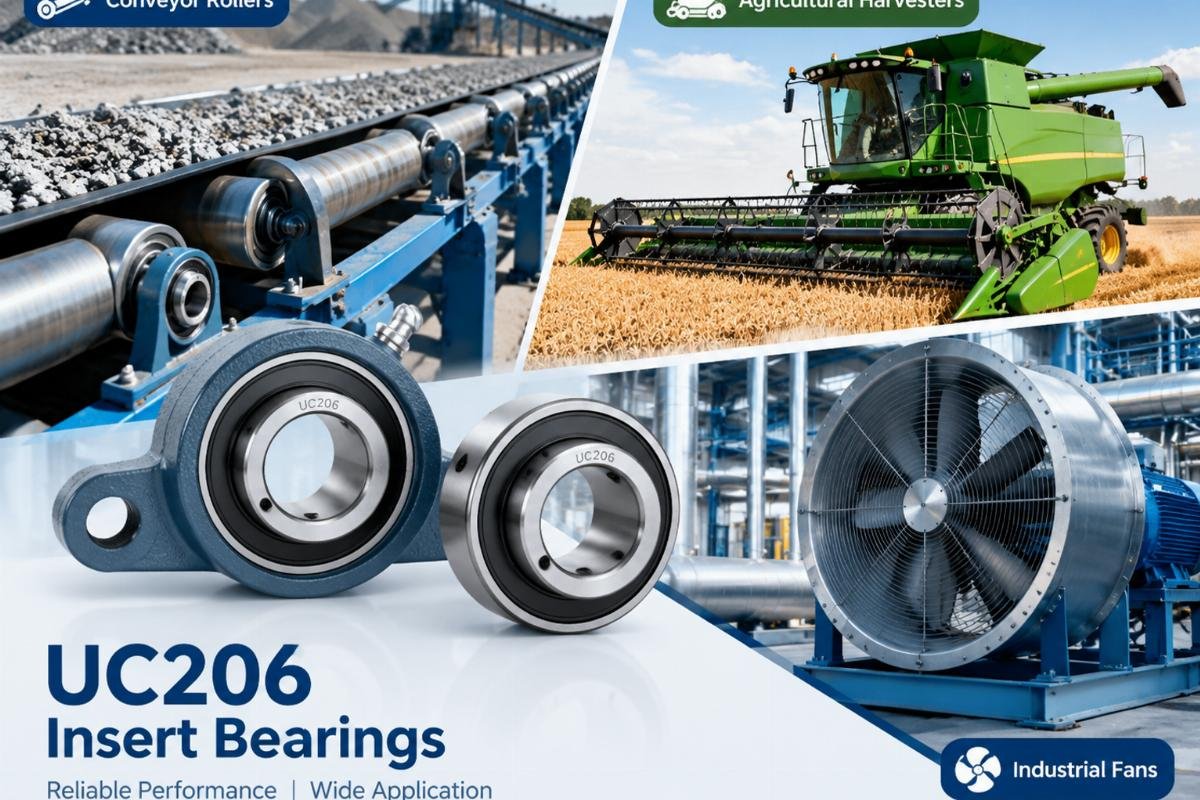
For distributors, understanding these use cases helps in recommending the right sealing options. A standard rubber seal might suffice for a clean HVAC fan, but an agricultural application requires heavy-duty labyrinths or flinger shields.
Why Do UC206 Bearings Fail in the Field?
Improper installation, dust ingress, and misalignment cause the majority of early failures.
Field data suggests that most UC206 failures are not due to material fatigue but to external factors. Understanding these failure modes can help extend service life significantly.
Dust ingress is the primary enemy. Even with seals, fine particulate matter can enter the bearing if the housing is damaged or if the seal lip is compromised. Once inside, abrasive particles mix with grease, forming a grinding paste that destroys the raceways. This is common in mining and cement plants. Regular inspection of seal integrity is essential.
Misalignment beyond the bearing’s capacity is another cause. While the UC206 can handle up to two degrees of misalignment, exceeding this limit causes the balls to ride on the edge of the raceway. This creates high stress concentrations, leading to spalling. Ensuring that the housing seats are parallel and the shaft is straight is critical during installation.
Lubrication issues are frequent. Over-greasing can blow out seals, allowing contaminants in. Under-greasing starves the rolling elements, causing metal-to-metal contact. The general rule is to fill the housing cavity one-third to one-half full, depending on speed. High-speed applications require less grease to prevent churning and overheating.
| Failure Mode | Root Cause | Prevention |
|---|---|---|
| Abrasive Wear | Dust ingress | Check seals, use labyrinth housings |
| Spalling | Excessive misalignment | Verify shaft straightness, limit angle |
| Overheating | Over-greasing or tight fit | Follow lubrication guidelines, check fits |
| Inner Ring Crack | Forced installation | Use proper tools, verify shaft size |
A Middle East steel mill reported frequent failures in their cooling tower fans. The UC206 bearings were lasting only a few months. Analysis showed that the maintenance team was using a high-pressure grease gun, forcing too much lubricant into the housing. This ruptured the seals, allowing water and dust to enter. Switching to a controlled manual greasing schedule extended the bearing life substantially. [NEED_CITE: lubrication best practices for insert bearings]

Conclusion
Precision in fit and care in installation define the success of a UC206 insert bearing.
The UC206 is a robust component, but it demands respect for its dimensional limits. Correct bore and housing fits ensure self-alignment works as intended. Proper sealing and lubrication protect against environmental hazards. For global buyers, sourcing genuine units with verified traceability ensures that these specifications are met. Whether for agricultural machinery or industrial conveyors, the right UC206 insert bearing delivers reliability when installed correctly.
Tags
Share this article

Written by
author
Editor covering global sourcing, supplier verification, and industrial product knowledge. Content is compiled from manufacturer specifications, industry standards, and hands-on experience with international B2B buyers. Every article is fact-checked before publishing to help procurement professionals make informed decisions.
More articles by author

