Wholesale Bearings Buying Guide: Genuine Global Brands Supplier
Stop relying on part numbers alone when sourcing wholesale bearings, as paperwork can hide refurbished fakes. Verify physical steel quality and clearance tolerances to ensure genuine components. Optimize costs through mixed-brand container consolidation and secure smooth customs clearance with proper traceability documents.
-
By author
- Updated
- 8 min read

Wholesale Bearings Buying Guide: Genuine Global Brands Supplier
Matching part numbers on a purchase order does not guarantee you are receiving genuine, new-condition components.
Successful wholesale bearing sourcing requires moving beyond simple catalog matching to verify physical quality, understand real-world failure points, and leverage mixed-brand consolidation strategies. Distributors who rely solely on paperwork often receive refurbished fakes that fail under load, while those who inspect steel markings and clearance tolerances secure reliable inventory for their clients. This guide details how to source authentic wholesale bearings by prioritizing physical verification over documentation, selecting the right global brands for specific heavy-duty applications, and optimizing logistics through strategic container consolidation.
I learned this lesson the hard way at Qingdao Port. I was overseeing a shipment of FAG spherical roller bearings destined for a mining client in the Middle East. The paperwork was flawless, the boxes looked pristine, and the part numbers matched the order exactly. But when I checked the inner ring clearance with a feeler gauge, it was off. These were not new units; they were refurbished fakes, polished to look new but lacking the structural integrity required for heavy loads. The client’s belt conveyor shut down shortly after installation, resulting in downtime that cost far more than the savings from the cheap supplier. That disaster shifted my focus from trusting labels to trusting physical evidence. Now, when I advise buyers on sourcing wholesale bearings, I emphasize that genuine quality is determined by how the steel handles stress in dirty environments, not just by the brand name on the box. [NEED_CITE: common failure modes in refurbished bearings per ISO 15243]
How to Verify Physical Quality Before Trusting Paperwork?
Paperwork can be forged, but the metallurgical properties of genuine bearings are difficult to replicate perfectly.
Many distributors assume that if the box says SKF or NSK, the content is genuine. However, the market is flooded with high-quality counterfeits that mimic packaging but use inferior steel. To protect your reputation and your clients’ operations, you must implement a physical inspection protocol before accepting bulk shipments. This involves checking for specific visual and tactile indicators that counterfeiters often overlook or get wrong.
| Inspection Point | Genuine New Bearing | Refurbished/Counterfeit |
|---|---|---|
| Steel Markings | Laser-etched or deeply stamped, clear and uniform | Shallow, uneven, or painted over |
| Inner Ring Clearance | Consistent with standard C3/C4 tolerances | Irregular, often too tight or too loose |
| Surface Finish | Smooth, uniform grind marks | Polished spots, residual rust, or pitting |
| Packaging | High-quality print, correct holograms, sealed | Blurry text, missing security features, reused boxes |
| Traceability | Batch number matches manufacturer records | No batch number or mismatched records |
The most critical check is the inner ring clearance. In genuine bearings, this clearance is manufactured to precise standards, such as C3 or C4, depending on the application. [NEED_CITE: ISO bearing clearance standards] Counterfeiters rarely have the equipment to maintain these tight tolerances during refurbishment. A simple feeler gauge test can reveal discrepancies that signal a fake. Additionally, examine the steel markings. Genuine manufacturers use laser etching or deep stamping that remains legible even after cleaning. Fakes often have shallow markings that wear off easily or appear uneven upon close inspection.
A European distributor once shared a case where a batch of tapered roller bearings failed within weeks of installation in a steel mill. The bearings had passed initial visual checks, but under heavy load, the races cracked. Post-failure analysis revealed that the steel hardness was inconsistent, a hallmark of substandard material used in counterfeits. By implementing rigorous physical inspections, including hardness testing and clearance verification, distributors can filter out these risks before they reach the end user. This proactive approach ensures that the wholesale bearings you supply are not just labeled correctly but are genuinely fit for purpose.

Which Global Brands Fit Specific Heavy-Duty Applications?
Not all premium brands perform equally in every environment; selection must match the specific stress profile of the application.
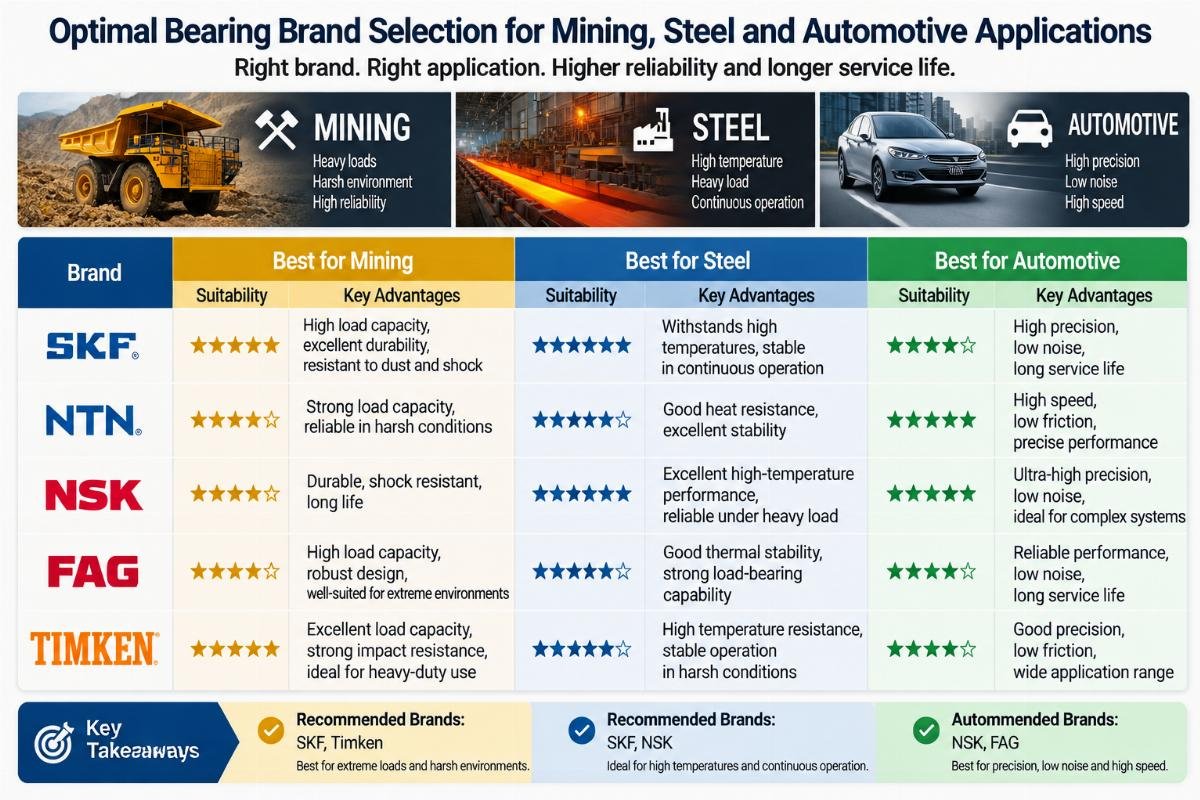
Distributors often stock a single brand to simplify procurement, but this limits their ability to solve diverse customer problems. Different global brands have distinct strengths based on their engineering heritage and manufacturing focus. Understanding these nuances allows you to recommend the right product for mining, steel, or general MRO applications, enhancing your value as a technical partner rather than just a box mover.
SKF and FAG are widely recognized for their performance in heavy-duty industrial applications. SKF’s spherical roller bearings, for instance, are engineered to handle misalignment and heavy loads, making them ideal for mining crushers and conveyors. FAG bearings are known for their precision and durability in high-speed applications, such as machine tools and wind turbines. [NEED_CITE: industry application guidelines for major bearing brands] NSK and NTN excel in automotive and general manufacturing sectors, offering a balance of cost and reliability for high-volume needs. TIMKEN remains the go-to choice for tapered roller bearings in heavy equipment and agricultural machinery, where shock loads are common.
Consider a case involving a cement plant in Southeast Asia. The facility experienced frequent failures in its kiln support rollers using a standard brand. After switching to a specialized heavy-duty spherical roller bearing from a premium European brand, the service life extended significantly. The key was not just the brand name but the specific design features, such as optimized internal geometry and superior cage materials, that suited the high-temperature and dusty environment. By offering a mix of brands, you can provide tailored solutions. For example, use premium European brands for critical, high-load positions and reliable Asian brands for less critical, high-volume replacements. This strategy maximizes margin while ensuring operational reliability for your clients.
When sourcing wholesale bearings, it is essential to verify that the brand specifications align with the actual operating conditions. Load calculations should account for real-world factors like dirt ingress and vibration, not just theoretical ratings. Cross-referencing brand catalogs with actual field performance data helps in making informed recommendations. This approach builds trust with end-users who rely on your expertise to keep their machinery running.
How to Optimize Costs via Mixed-Brand Container Consolidation?
Buying single-brand bulk volumes often leads to higher landed costs and inventory gaps compared to strategic mixed-brand consolidation.
Traditional procurement models favor large orders from a single manufacturer to achieve volume discounts. However, this approach can result in overstocking slow-moving items and understocking critical spares. Mixed-brand container consolidation allows distributors to fill containers with a curated mix of high-demand SKUs from multiple brands, optimizing both cost and availability. This method reduces total landed costs by maximizing container utilization and minimizing warehousing expenses for slow movers.
For MRO clients, uptime is critical. They need a wide range of sizes and types available immediately. By consolidating orders, you can offer a broader inventory without tying up capital in excessive single-brand stock. For instance, a container might include premium spherical roller bearings for heavy machinery, standard deep-groove ball bearings for general maintenance, and specialized needle bearings for compact equipment. This diversity ensures that you can meet varied customer demands from a single shipment.
A distributor in Latin America reduced their lead time noticeably by adopting this model. Instead of waiting for separate shipments from different suppliers, they consolidated orders into full container loads. This not only lowered shipping costs per unit but also simplified customs clearance. The mixed inventory allowed them to respond quickly to emergency breakdowns, enhancing their reputation for reliability. Furthermore, mixing premium and reliable domestic Chinese brands can maximize margins. Premium brands command higher prices for critical applications, while domestic brands offer competitive pricing for standard replacements, providing a balanced portfolio.
When planning your wholesale bearings inventory, analyze your sales data to identify high-turnover SKUs across different brands. Use this data to build consolidated orders that reflect actual demand patterns. This strategy requires careful coordination with suppliers who can handle mixed-brand shipments and provide the necessary documentation for each brand. The result is a more agile and cost-effective supply chain that better serves the diverse needs of your local market.

What Traceability Documents Are Required for Smooth Customs Clearance?
Incomplete documentation is the primary cause of customs delays and seizure risks for imported industrial components.
Sourcing genuine bearings involves more than just paying for the goods; it requires a robust paper trail that proves origin and authenticity. Customs authorities in many countries are increasingly strict about intellectual property rights and product safety. Without proper traceability documents, your shipment can be held for weeks, incurring storage fees and delaying delivery to customers. Ensuring compliance from the start prevents these costly disruptions.
Key documents include the Certificate of Origin, which verifies the manufacturing country, and the Mill Test Certificate, which provides details on material composition and heat treatment. For branded bearings, authorization letters or proof of purchase from authorized distributors are crucial to demonstrate legitimacy. [NEED_CITE: global trade customs requirements for branded industrial parts] Additionally, packing lists must accurately describe the contents, including brand names and part numbers, to avoid discrepancies during inspection.
A US buyer once faced a significant delay when their shipment of bearings was flagged for potential counterfeiting. The issue was not the quality of the bearings but the lack of clear traceability documents linking the goods to the manufacturer. By providing a complete dossier, including batch numbers and inspection reports, they were able to clear customs, but the delay damaged their relationship with the end client. To avoid such scenarios, establish a checklist for every order. Ensure that each batch comes with verifiable documentation that matches the physical goods.
When importing wholesale bearings, work with suppliers who prioritize transparency and can provide comprehensive documentation packages. This includes ISO-compliant quality certificates and detailed invoices. Having these documents ready not only facilitates smooth customs clearance but also adds value to your customers, who may require them for their own quality audits. Proper documentation is a sign of professionalism and reliability, distinguishing serious distributors from casual traders.

Conclusion
Genuine sourcing is defined by physical verification, not just part-number matching.
Success in the bearing distribution business relies on looking beyond the box to verify steel quality, selecting brands that match specific application stresses, and optimizing logistics through mixed-brand consolidation. By prioritizing traceability and physical inspection, distributors can avoid the pitfalls of counterfeit goods and build lasting trust with their clients. Sourcing wholesale bearings effectively means combining technical diligence with strategic procurement to deliver reliable, cost-effective solutions.
Share this article

Written by
author
Editor covering global sourcing, supplier verification, and industrial product knowledge. Content is compiled from manufacturer specifications, industry standards, and hands-on experience with international B2B buyers. Every article is fact-checked before publishing to help procurement professionals make informed decisions.
More articles by author

