6303 Bearing Dimensions & Applications: Wholesale Supplier for Sale
Stop costly mismatches by mastering 6303 bearing dimensions and seal selection for your specific environment. Learn why the standard 17x47x14mm size requires precise CN or C3 clearance choices to prevent premature seizure in high-temperature or dusty industrial applications.
-
By author
- Updated
- 7 min read
6303 Bearing Dimensions & Applications: Wholesale Supplier for Sale
Most buyers assume the cheapest open bearing saves money; in dusty environments, it costs far more in downtime.
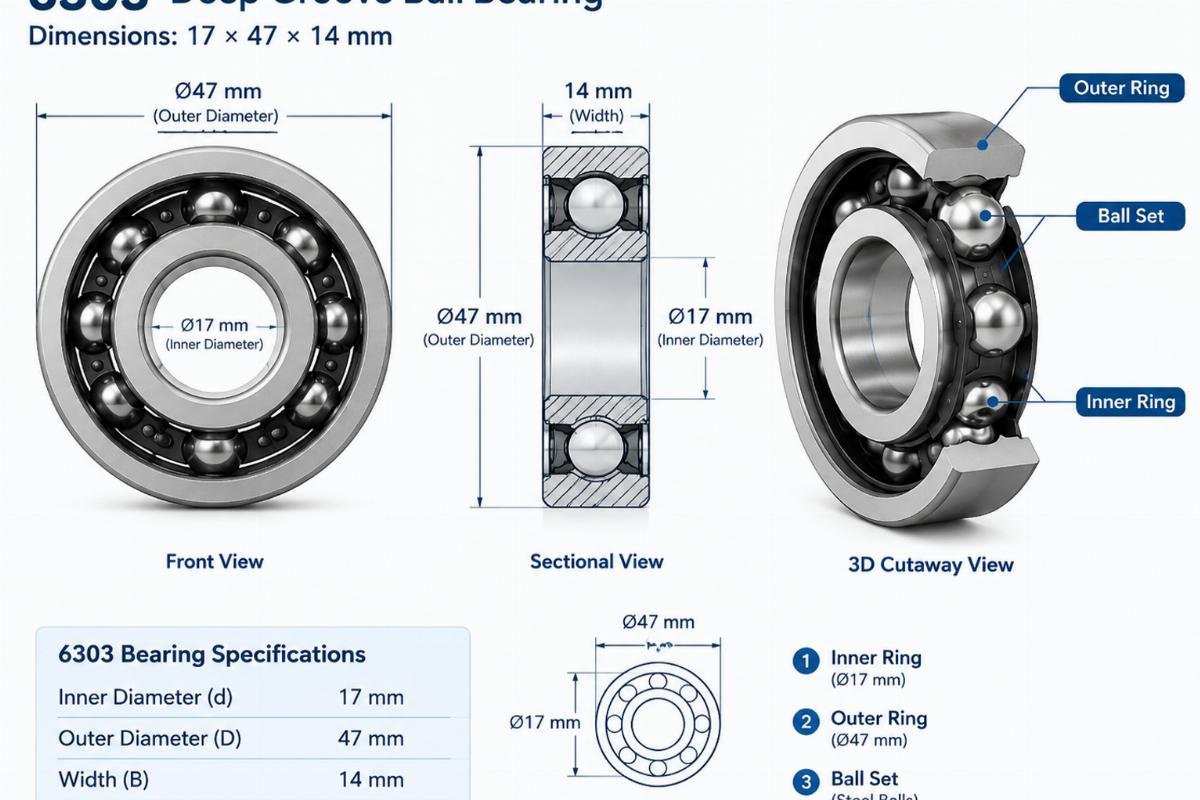
A 6303 bearing is a deep groove ball bearing with standard dimensions of 17mm inner diameter, 47mm outer diameter, and 14mm width. Selecting the correct seal type (Open, ZZ, or 2RS) and internal clearance (CN or C3) based on operating temperature and contamination levels is critical to preventing premature failure. While the physical size remains constant across variants, mismatching these internal specifications to the application environment leads to rapid seizure or excessive vibration, regardless of the brand authenticity.
I still recall the sting of a claim from a US MRO distributor years ago. They had ordered a bulk batch of standard open-type units for agricultural conveyors, assuming the basic 6303 bearing dimensions were sufficient for their needs. I had quoted the part number without probing into the field conditions. Within weeks, the bearings seized up due to dust ingress, costing them significant maintenance hours and replacement parts. That incident shifted my approach entirely. Now, I never just sell a part number; I dig into the working conditions to ensure the right seal and clearance are matched to the actual application. This experience underscores that dimensional compliance is merely the baseline, not the solution.
Understanding these specifications helps buyers avoid costly mismatches. The following sections break down how to select the right variant for your specific industrial environment.
What Are the Exact Dimensions of a 6303 Bearing?
The 17x47x14mm footprint is standardized globally, but tolerance classes determine fit and performance.
The core identity of a 6303 bearing lies in its metric dimensions: 17mm bore, 47mm outside diameter, and 14mm width. These measurements adhere to ISO 492 standards, ensuring interchangeability across major manufacturers like SKF, FAG, and NSK [NEED_CITE: ISO 492 dimensional tolerances for radial bearings]. However, simply matching these three numbers is insufficient for high-precision applications. The critical differentiator is the tolerance class, such as P0 (normal) or P6 (higher precision), which dictates the allowable deviation in roundness and runout.
For most general industrial uses, normal tolerance suffices. Yet, in high-speed motor applications, even micron-level deviations can cause vibration and heat buildup. Buyers often overlook this, focusing solely on the outer dimensions while ignoring the internal geometry that affects load distribution. When sourcing a 6303 bearing, verifying the tolerance class against your machinery’s design requirements prevents issues like tight fits causing raceway deformation or loose fits leading to creep.

Ensuring dimensional accuracy requires more than a caliper check; it demands traceability documentation from the supplier. This is where genuine stock from reputable channels becomes vital, as counterfeit parts often fail to meet these strict ISO tolerances despite appearing visually identical.
How Do 6303 Seal Types Impact Application Lifespan?
Choosing the wrong seal turns a durable component into a single-use consumable in harsh environments.
The 6303 bearing comes in three primary seal configurations: Open, ZZ (metal shield), and 2RS (rubber seal). Each serves a distinct purpose, and mismatching them to the environment is a common cause of early failure. An open bearing offers minimal friction and is suitable for clean, lubricated housings, but it provides zero protection against contaminants. In contrast, the 2RS variant uses rubber seals on both sides, offering superior protection against dust and moisture, making it ideal for agricultural or construction machinery. The ZZ type strikes a balance, using metal shields to keep out large particles while allowing higher speed operation than rubber seals.
| Seal Type | Contamination Protection | Speed Capability | Friction Torque | Best Use Case |
|---|---|---|---|---|
| Open | None | Highest | Lowest | Clean, oil-bath lubricated housings |
| ZZ (Metal Shield) | Basic (Large particles) | High | Low | General electric motors, gearboxes |
| 2RS (Rubber Seal) | Robust (Dust/Moisture) | Moderate | Higher | Agricultural equipment, conveyors |
A European wind farm operator once faced repeated failures in their auxiliary motor drives. They had specified open bearings to minimize friction, ignoring the saline mist present in their coastal location. The corrosion led to rapid degradation. Switching to sealed variants extended the service life meaningfully, reducing maintenance frequency significantly. This case highlights that the initial cost premium for a sealed 6303 2RS bearing is negligible compared to the downtime costs of an open bearing in a contaminated setting.

When selecting a seal, consider the operating environment first. If dust or moisture is present, the rubber seal’s protection outweighs its slight increase in friction torque. For high-speed applications where heat generation is a concern, the metal shield may be preferable, provided the housing offers some external protection.
Which Industries Rely Most on 6303 Bearings?
Versatility makes the 6303 a staple across sectors, but each industry imposes unique stress profiles.
The 6303 bearing is ubiquitous in industries ranging from agriculture to electric motor manufacturing. Its compact size and robust load capacity make it a default choice for many OEM designs. In agricultural machinery, such as combine harvesters and conveyor systems, these bearings endure heavy shock loads and extreme contamination. Here, the demand for durable seals is paramount. A failure in this sector doesn’t just stop a machine; it can delay an entire harvest season, leading to substantial financial loss.
In the electric motor industry, the focus shifts to noise and vibration. Manufacturers require bearings with consistent internal geometry to ensure smooth operation at high RPMs. The 6303 ZZ bearing applications are prevalent here, as the metal shields protect against minor debris without adding significant drag. Conversely, in heavy equipment like excavators, the bearings face continuous vibrational stress and potential misalignment. Sourcing genuine products with verified material quality ensures they can withstand these dynamic loads without premature fatigue crack initiation [NEED_CITE: ABMA/ANSI standards for bearing load ratings].

For MRO managers, understanding these industry-specific demands helps in stocking the right variants. Keeping a mix of sealed and open types allows for quick replacement tailored to the specific machine being repaired, rather than applying a one-size-fits-all approach that may compromise performance.
How to Select the Right Internal Clearance?
Larger clearance isn’t always safer; it can cause severe vibration in standard-precision applications.
Internal clearance refers to the space between the rolling elements and the raceways. The two most common classes for a 6303 bearing are CN (normal) and C3 (greater than normal). Many buyers mistakenly believe that C3 clearance is universally better because it accommodates thermal expansion. However, in applications with stable temperatures and precise shaft fits, C3 clearance can lead to excessive play, resulting in noise and reduced bearing life.
Thermal expansion is the key driver for choosing C3. In high-temperature environments, such as near furnaces or in heavily loaded gearboxes, the inner ring expands more than the outer ring, reducing internal clearance. If a CN bearing is used here, it may seize as the clearance disappears. A C3 bearing provides the necessary extra space to accommodate this expansion, maintaining optimal operation. Conversely, in standard ambient conditions, a CN bearing ensures tighter control over shaft movement, enhancing precision.
| Clearance Class | Thermal Suitability | Vibration Risk | Typical Application |
|---|---|---|---|
| CN (Normal) | Standard Ambient | Low in precise fits | General motors, pumps, fans |
| C3 (Greater) | High Temperature | High in loose fits | Heavy loads, high-temp gearboxes |
A Middle East steel mill experienced frequent motor seizures during summer months. Investigation revealed that standard CN bearings were being used in high-heat zones. The thermal expansion eliminated the internal clearance, causing the balls to bind. Switching to C3 variants resolved the issue, allowing the equipment to run substantially longer without overheating. This example illustrates that clearance selection must align with thermal conditions, not just mechanical fit.

When sourcing, specify the clearance class explicitly. Many suppliers default to CN unless requested otherwise. For critical applications, verifying the clearance class through technical datasheets ensures the bearing matches the operational thermal profile.
Conclusion
Matching seal type and clearance to the environment prevents failure more effectively than brand alone.
Selecting the right 6303 bearing involves more than confirming its 17x47x14mm dimensions. It requires a clear understanding of the operating environment, including contamination levels and thermal conditions. By choosing the appropriate seal variant and internal clearance, buyers can significantly extend equipment life and reduce unplanned downtime. Genuine sourcing with proper technical consultation ensures these specifications are met reliably.
Tags
Share this article

Written by
author
Editor covering global sourcing, supplier verification, and industrial product knowledge. Content is compiled from manufacturer specifications, industry standards, and hands-on experience with international B2B buyers. Every article is fact-checked before publishing to help procurement professionals make informed decisions.
More articles by author

