6304 Bearing Specs & Equivalents: Wholesale Supplier
Master 6304 bearing specs and equivalents by looking beyond basic 20x52x15mm dimensions to critical suffixes. True cross-brand interchangeability depends on internal clearance like C3 and seal types to prevent thermal binding. Verify quality through traceability and rotational testing for reliable motor performance.
-
By author
- Updated
- 7 min read
6304 Bearing Specs & Equivalents: Wholesale Supplier
Matching basic dimensions is merely the baseline for interchangeability.
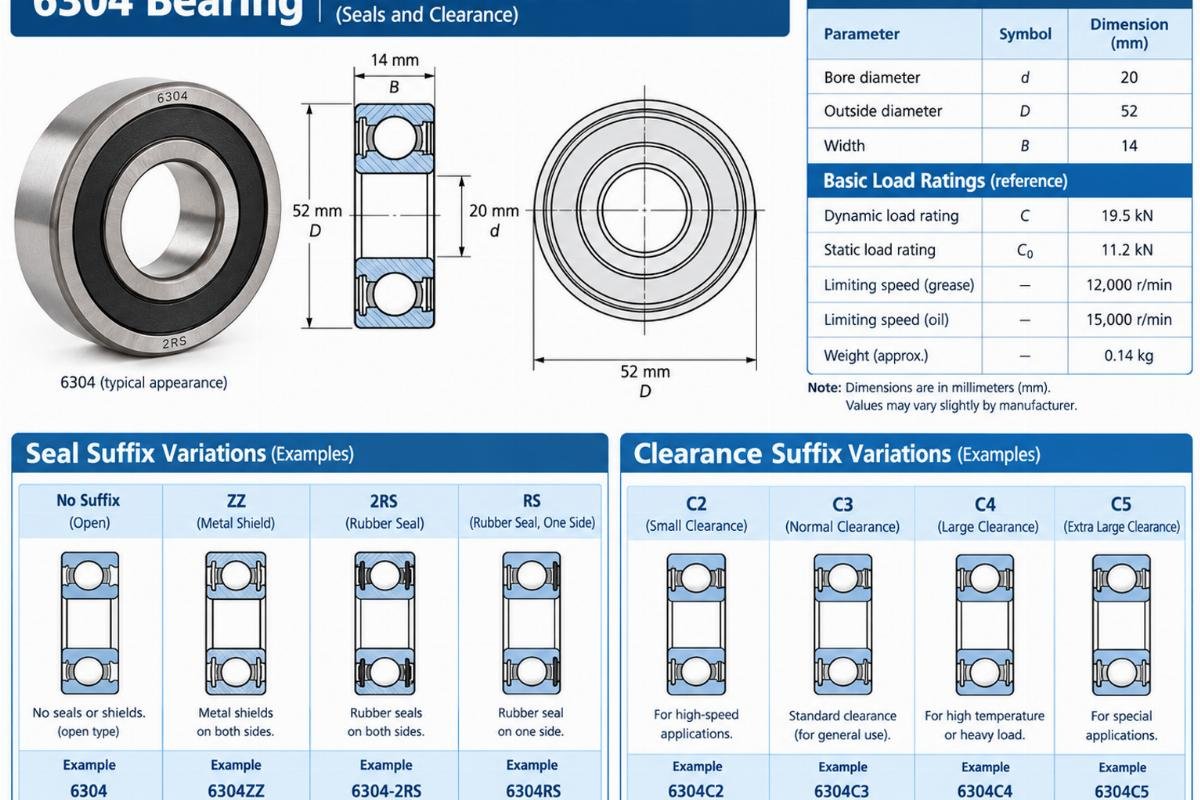
The core specifications for a 6304 bearing are a 20mm bore, 52mm outer diameter, and 15mm width. However, true cross-brand equivalence depends entirely on suffixes defining internal clearance, seal type, and cage material, not just these physical dimensions.
I still remember the humidity in the warehouse at Ningbo Beilun Port, watching a container being sealed for a client in the Middle East. The order was straightforward: replace a specific European brand’s 6304 deep groove ball bearing with a domestic alternative to cut costs. On paper, the part numbers matched perfectly. The dimensions were identical. I assumed it was a direct swap. Weeks later, the complaint arrived not via email, but through a frantic video call showing a motor vibrating so violently it walked across the factory floor. The issue was not the steel quality or the dimensional accuracy. It was the internal clearance. The original specification required a C3 clearance for high-temperature operation, but the equivalent supplied had standard CN clearance. The thermal expansion locked the rolling elements, causing catastrophic failure. That incident reshaped my approach to sourcing. I learned that while the 6304 bearing specs provide the skeleton, the suffixes dictate the soul of the component. [NEED_CITE: ISO 5753 standards for radial internal clearance]
Understanding this distinction is critical for distributors and OEMs who rely on cross-referencing. A 6304 bearing is not a monolithic product; it is a platform for various engineering configurations. When you search for a 6304 bearing cross reference, you are often looking for more than just a size match. You are seeking a functional equivalent that withstands the same operational stresses.
What Are the Core Specs of a 6304 Bearing?
Basic dimensions form the non-negotiable foundation of any 6304 replacement.
The 6304 deep groove ball bearing dimensions are standardized globally under ISO 492. Any legitimate equivalent must adhere strictly to these measurements to fit into existing housings and shafts. The bore diameter is 20mm, the outer diameter is 52mm, and the width is 15mm. Deviations in these primary dimensions, even by microns, can lead to improper fitment, either too loose causing slippage or too tight causing installation damage.
Beyond physical size, the load ratings define the bearing’s capacity. The dynamic load rating indicates how much load the bearing can endure while rotating, while the static load rating applies to stationary conditions. These values vary slightly between manufacturers due to differences in steel purity and heat treatment processes, but they generally fall within a predictable range for standard carbon chrome steel. [NEED_CITE: ABMA/AFBMA guidelines for load rating calculations]
| Parameter | Specification | Note |
|---|---|---|
| Bore Diameter | 20 mm | Standard metric size |
| Outer Diameter | 52 mm | Must match housing |
| Width | 15 mm | Critical for axial space |
| Ball Material | Chrome Steel | Standard GCr15/SAE 52100 |
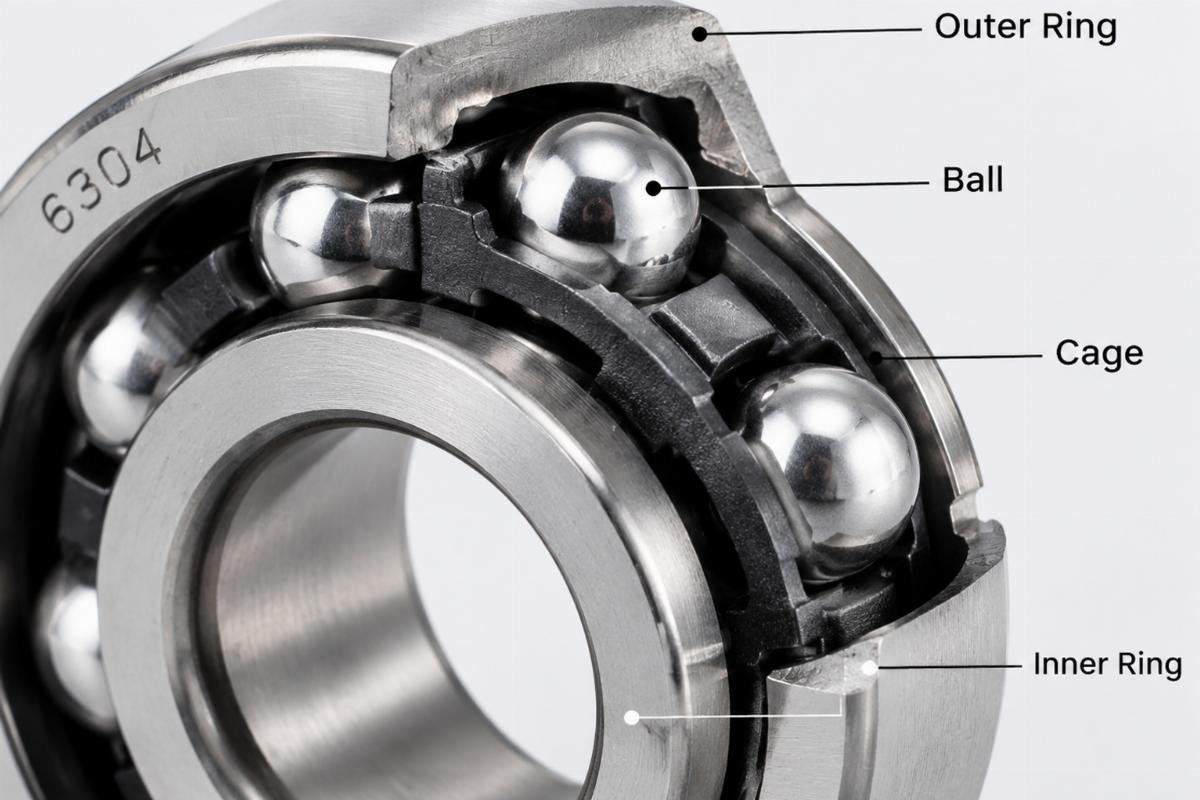
| Cage Type | Stamped Steel | Standard for general use |
When evaluating a 6304 bearing cross reference, start with these hard numbers. If a supplier cannot guarantee these dimensions within standard tolerances, the conversation should end there. However, meeting these specs is only the entry ticket. Many failures occur because buyers stop checking after confirming the 20x52x15mm size, ignoring the internal architecture that determines performance under load.
How Do Suffixes Define 6304 Equivalents Across Brands?
Suffixes are the universal language of bearing interchangeability, mapping features across different manufacturers.
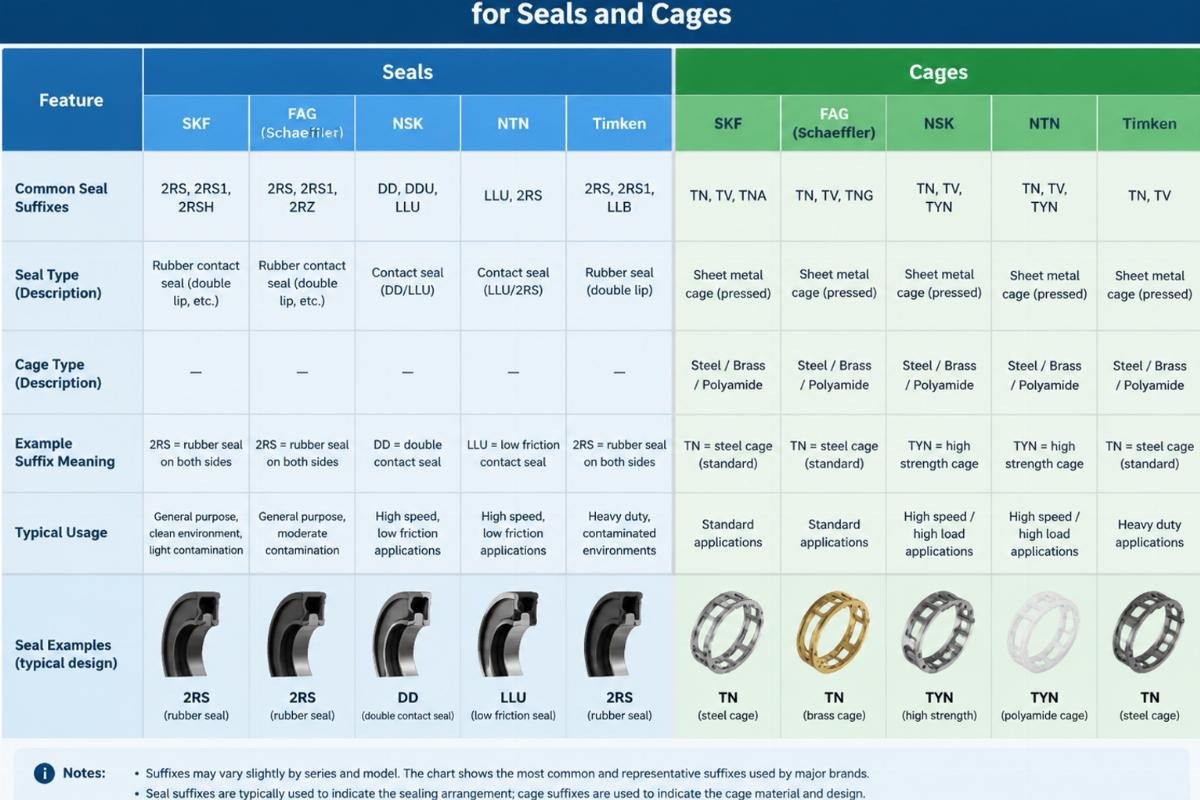
A major pitfall in global sourcing is assuming that a “6304” from one brand is identical to a “6304” from another. In reality, the base number is incomplete without its suffixes. Different brands use different codes for the same features. For instance, a metal shield might be denoted as ZZ by one manufacturer and 2Z by another. A rubber seal could be 2RS, RSH, or DDU depending on the brand’s naming convention. [NEED_CITE: Cross-reference suffix mapping guidelines from major bearing catalogs]
Consider a scenario involving a gearbox overhaul for a mining client. The original equipment used bearings with specific cage materials designed for high-speed stability. When sourcing a 6304 bearing cross reference, we had to ensure the replacement not only matched the seal type but also the cage design. A stamped steel cage is common, but for higher speeds or heavier loads, a machined brass or polyamide cage might be specified. Mixing these up can lead to cage fracture under centrifugal force.
| Feature | SKF Code | FAG Code | NSK Code | Generic Equivalent |
|---|---|---|---|---|
| Metal Shield | Z / ZZ | Z / ZZ | Z / ZZ | 2Z |
| Rubber Seal | RS1 / 2RS1 | RS / 2RS | V / VV | 2RS |
| C3 Clearance | C3 | C3 | C3 | C3 |
| Machined Brass Cage | M | M | M | M |
Navigating these differences requires a detailed cross-reference matrix. For distributors stocking multi-brand inventory, understanding these mappings is essential to prevent sending the wrong variant. A client once requested an SKF 6304 equivalent for a pump application. The original had double rubber seals. We sourced a reputable alternative but initially missed that the suffix indicated a single seal with a dust cover on the other side. This mismatch would have allowed contaminants to enter the bearing from one side. Catching this discrepancy before shipment saved the client from a costly field failure. [NEED_CITE: Manufacturer technical catalogs for suffix definitions]
Why Does Internal Clearance (C3 vs CN) Matter in Equivalents?
Internal clearance dictates thermal behavior and is the most common cause of equivalent bearing failure.
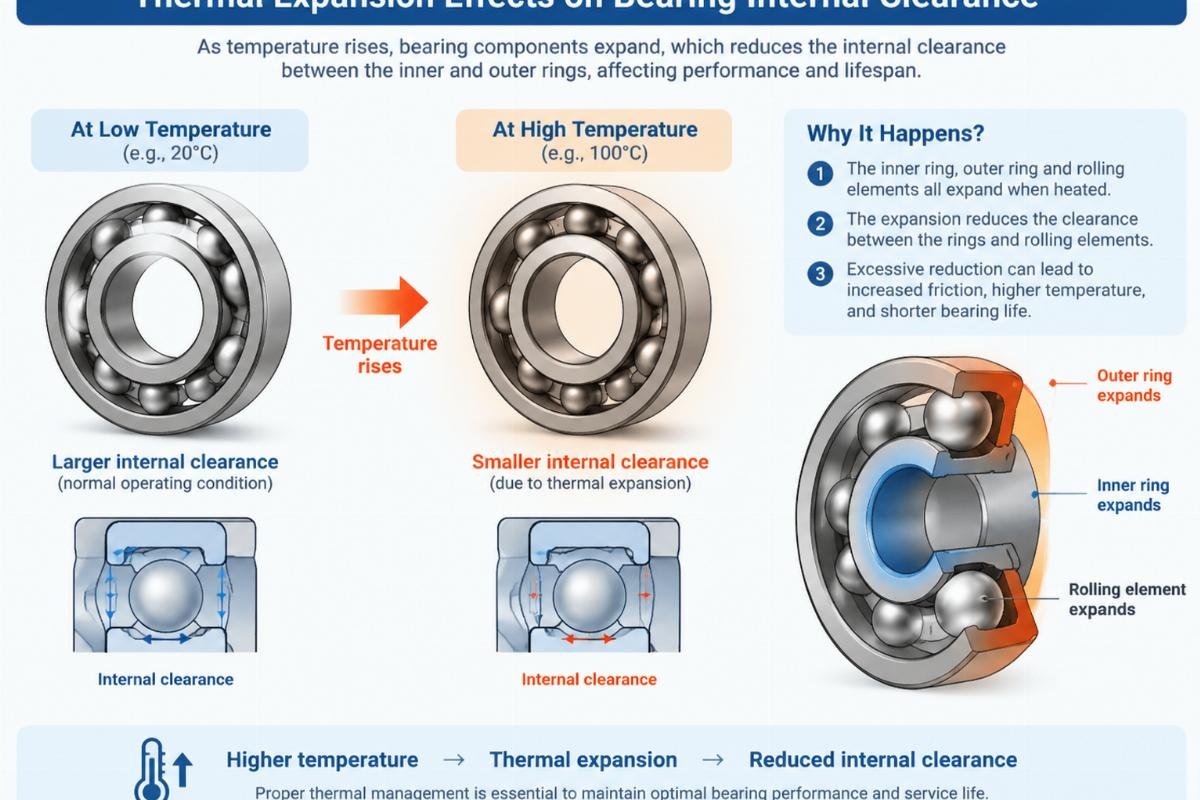
The term “6304 C3 clearance” refers to a radial internal clearance greater than the standard normal (CN) group. This extra space allows the bearing components to expand as they heat up during operation without creating excessive preload. In applications like electric motors, where temperatures rise significantly, using a standard clearance bearing instead of a C3 variant can lead to thermal binding. The balls become trapped between the races, generating immense friction, heat, and eventually, seizure.
I recall a case with a European wind farm operator who experienced repeated bearing failures in their generator gearboxes. They were sourcing replacements based solely on the 6304 deep groove ball bearing dimensions. The originals were specified with C3 clearance to handle the thermal expansion from continuous operation. The cheaper equivalents they found online had standard CN clearance. Within months, the vibration levels spiked, leading to unplanned downtime. The cost of the downtime far exceeded the savings from the cheaper bearings.
Selecting the correct clearance is not just about temperature. It also affects noise and stiffness. A C3 clearance might result in slightly higher noise levels at low speeds compared to CN, but it is necessary for high-speed or high-temperature environments. Conversely, using C3 in a precision machine tool application where rigidity is paramount could lead to unacceptable deflection. [NEED_CITE: ISO 5753 classification for radial internal clearance]
When verifying a 6304 bearing cross reference, always confirm the clearance class. Do not assume it is standard. Ask for the specific suffix. If the application involves significant heat generation or interference fits on both the shaft and housing, C3 is likely required. Ignoring this detail turns a precise engineering component into a ticking time bomb.
How to Verify Quality When Sourcing 6304 Equivalents?
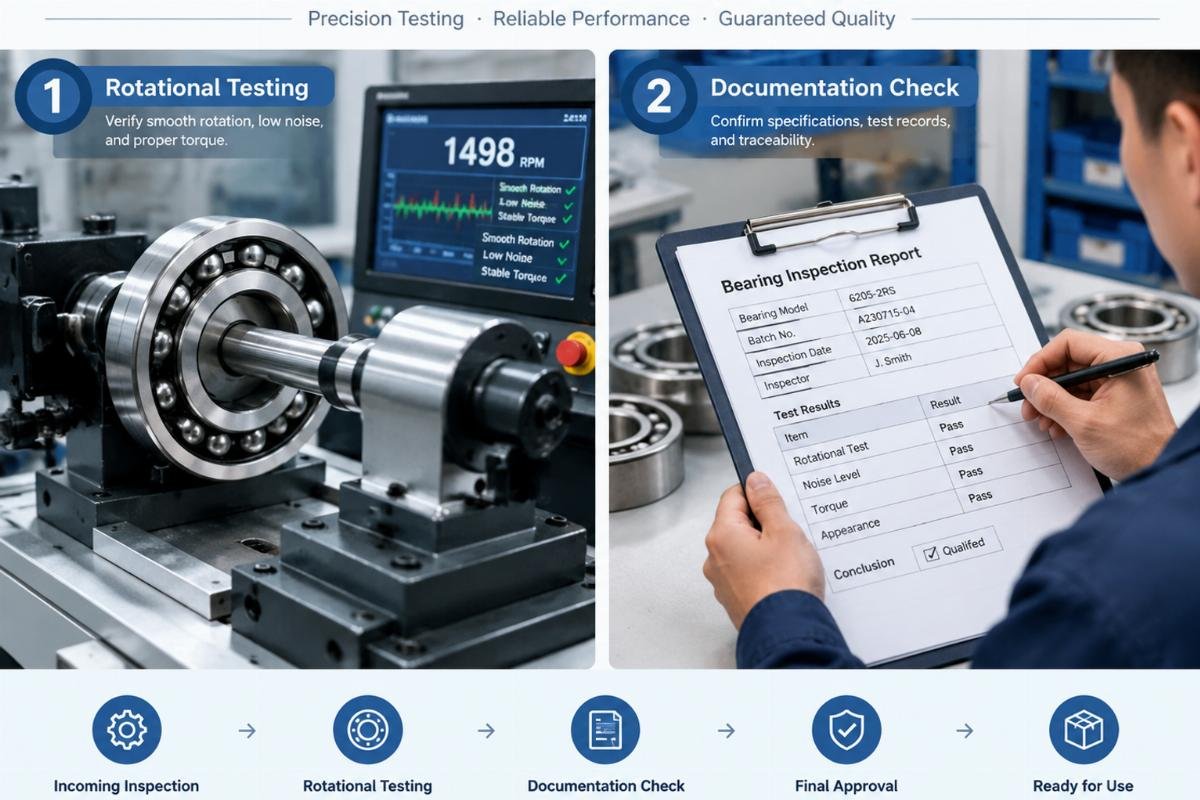
Traceability and rotational testing are the definitive checks for genuine quality in bulk sourcing.
Sourcing equivalents is not just about finding a lower price; it is about ensuring consistency. A batch of bearings might look identical externally, but internal defects such as poor raceway finish or contaminated grease can lead to premature failure. For MRO buyers and distributors, verifying quality requires going beyond the datasheet.
One effective method is to request traceability documentation. Genuine bearings from reputable manufacturers come with batch numbers that link back to production records. This ensures that the steel used meets the required purity standards. Additionally, rotational vibration tests can detect subtle imperfections in the raceways or balls that visual inspection misses. A high-quality 6304 bearing should rotate smoothly with minimal resistance and no audible grittiness.
In our operations, we often consolidate mixed containers for clients who need various brands and sizes. This allows us to perform spot checks on incoming stock. We look for consistent packaging, clear marking of the suffixes, and smooth rotation. A recent audit of a new supplier revealed that while their 6304 bearing specs matched on paper, the grease filling was inconsistent, leading to varying torque levels across the batch. Rejecting this shipment prevented potential issues for our clients’ high-speed spindle applications.
Quality verification also involves checking the cage material. As mentioned earlier, the cage must suit the application’s speed and load requirements. Visual inspection can sometimes reveal poor finishing on stamped cages, which can act as stress concentrators. For critical applications, requesting sample units for bench testing before committing to a full container load is a prudent strategy. This approach minimizes the risk of batch rejections and ensures that the equivalents perform as expected in the field. [NEED_CITE: ISO 9001 quality management principles for supply chain verification]
Conclusion
Dimensions are the starting point, but suffixes determine survival.
Successfully sourcing a 6304 bearing equivalent requires looking past the basic 20x52x15mm measurements. The true interchangeability lies in the details of internal clearance, seal types, and cage materials. By understanding and verifying these suffixes, buyers can avoid costly failures and ensure reliable performance in demanding applications. Always prioritize traceability and technical compatibility over simple price comparisons to secure long-term operational stability.
Tags
Share this article

Written by
author
Editor covering global sourcing, supplier verification, and industrial product knowledge. Content is compiled from manufacturer specifications, industry standards, and hands-on experience with international B2B buyers. Every article is fact-checked before publishing to help procurement professionals make informed decisions.
More articles by author

