Bearing Distributor Inventory Turnover Benchmarks for Wholesale Buyers
Optimize your bearing distributor inventory benchmarks to align stock with end-user demand rather than maximizing speed. Target a healthy turnover range of three to six times annually while balancing SKU depth for heavy industry and breadth for general manufacturing. Reduce hidden carrying costs through flexible multi-brand sourcing strategies.
-
By author
- Updated
- 6 min read

Bearing Distributor Inventory Turnover Benchmarks for Wholesale Buyers
Higher turnover is not always better.
For bearing distributors, the ideal inventory turnover rate typically ranges between three to six times annually. This benchmark varies significantly based on regional end-user mix and product category. Heavy industry sectors require deeper stock of specific spherical roller bearings, while general manufacturing demands broader availability of standard deep-groove ball bearings. The primary goal is not maximizing speed but aligning stock levels with specific demand patterns to protect cash flow and reduce dead stock costs.
I still remember the humidity in the Qingdao port warehouse during my early days in procurement. I had followed conventional wisdom, stocking up heavily on fast-moving deep-groove ball bearings. The shelves were full, and the turnover looked impressive on paper. Then a major steel mill announced an unexpected technical overhaul. Their urgent need was not for standard ball bearings, but for large-size spherical roller bearings that I had barely stocked. Meanwhile, my regular inventory sat idle, tying up capital that I desperately needed for emergency air freight. That experience reshaped my understanding of bearing distributor inventory benchmarks. It is not about how fast you sell everything, but about having the right part when the machine stops. [NEED_CITE: impact of stockouts on industrial maintenance downtime]
Many wholesalers mistake high velocity for efficiency. In reality, aggressive turnover targets can lead to critical stockouts in heavy-equipment repairs, where lead times are long and penalties for downtime are severe. Understanding the nuance behind bearing distributor inventory benchmarks requires looking beyond the spreadsheet and into the operational reality of your clients.
What is the Ideal Inventory Turnover Rate for Bearing Distributors?
There is no single universal number, but data suggests a healthy range of three to six turns per year for most multi-brand distributors.
This range balances the cost of holding inventory against the risk of stockouts. A rate below three often indicates overstocking and capital inefficiency, while a rate above six may signal insufficient buffer stock for unpredictable demand spikes. The variation depends heavily on the product mix. Standard commercial bearings move faster, while precision or large-size industrial bearings move slower but carry higher margins and criticality.
Consider the difference between serving a local automotive repair cluster versus a regional mining operation. The former needs quick access to common wheel hub units and small ball bearings, driving higher turnover. The latter requires massive, slow-moving spherical and tapered roller bearings that may sit for months but are vital for continuous operation. Ignoring this distinction leads to distorted metrics. [NEED_CITE: industry standards for MRO supply chain inventory ratios]
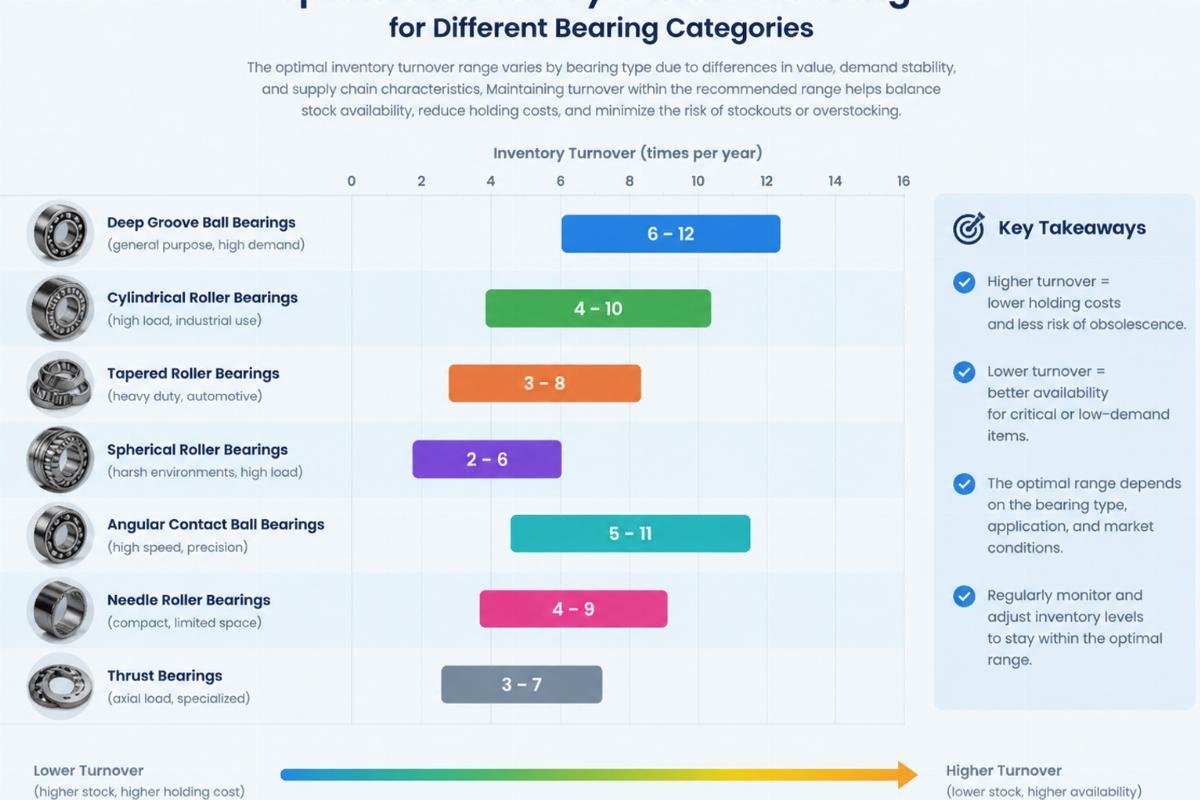
When evaluating bearing distributor inventory benchmarks, segment your portfolio. Do not apply the same target to a high-volume deep-groove series as you would to a specialized thrust bearing. A blended average can hide both excess stock in slow lines and dangerous shortages in fast lines. Use weighted averages based on revenue contribution rather than unit count to get a true picture of financial health.
How Do End-User Scenarios Dictate Your Stock Strategy?
Heavy industry requires depth in specific critical SKUs, while general manufacturing demands breadth in standard parts.
A regional MRO hub often faces the 80/20 rule: twenty percent of SKUs generate eighty percent of transaction volume, but the remaining eighty percent are essential for customer retention and complete service offerings. Balancing these two demands is the core challenge. For example, a steel mill overhaul scenario might see a sudden surge in demand for specific spherical roller bearings, shifting the required stock ratio dramatically compared to normal operations.
In contrast, a distributor serving general manufacturing machinery builders needs consistent availability of standard deep-groove and angular contact bearings. Here, stockouts are less about emergency breakdowns and more about production line continuity. The strategy shifts from reactive emergency fulfillment to proactive planned replenishment. [NEED_CITE: demand pattern analysis for industrial vs. OEM bearing supply]

Applying bearing distributor inventory benchmarks without context is risky. If you serve a mixed client base, your inventory must reflect that hybrid nature. Keep a leaner, faster-turning stock for standard items and a strategic, deeper stock for critical industrial sizes. This approach prevents capital from being trapped in slow-moving generic parts while ensuring you can support high-value emergency calls.
How to Calculate Hidden Costs of Overstocking?
Warehousing, insurance, and capital opportunity costs often exceed the margin on slow-moving SKUs.
Many distributors focus only on the purchase price and selling price, ignoring the carrying cost of inventory. This cost includes physical storage space, insurance premiums, risk of obsolescence, and the opportunity cost of tied-up capital. For slow-moving brands or oversized bearings, these hidden costs can erode profitability significantly. A bearing sitting on a shelf for two years may technically be an asset, but financially it is a liability.
Calculating Days Sales of Inventory (DSI) for mixed-brand portfolios provides a clearer view. High DSI values indicate that cash is locked in stock for extended periods. When combined with ABC analysis tailored for multi-brand bearing categories, you can identify which items are draining resources. Class A items (high value, high movement) need tight control, while Class C items (low value, low movement) should be minimized or sourced on demand. [NEED_CITE: methodology for calculating total cost of ownership in inventory management]

Using bearing distributor inventory benchmarks helps set limits on DSI. If your DSI for a specific brand exceeds industry norms, it is time to review purchasing terms or liquidate excess stock. Flexible sourcing options become crucial here. Instead of buying full container loads of slow-moving items, consider consolidating shipments with other products to reduce minimum order quantities and free up cash flow.
How to Optimize Multi-Brand Sourcing Without Overstocking?
Flexible MOQs and mixed-container consolidation allow distributors to maintain wide SKU width with lower capital risk.
The traditional model of buying full containers of a single brand forces distributors to overstock to achieve freight efficiency. This leads to dead stock warehousing costs for slow-moving brands. Modern sourcing strategies emphasize flexibility. By consolidating multiple brands and sizes into a single container, you can achieve freight economies without committing to excessive volumes of any single SKU. This approach supports a broader product offering while keeping inventory levels aligned with actual demand.
For instance, combining premium global brands with reliable domestic lines in one shipment allows you to cater to different price segments without doubling your inventory investment. This mixed-brand strategy reduces the risk of capital tie-up in any single product line. It also provides customers with more choices, enhancing your competitive position in the market. [NEED_CITE: benefits of consolidated shipping for SME distributors]

Implementing bearing distributor inventory benchmarks in your sourcing decisions means negotiating for flexibility. Seek suppliers who offer mixed-container consolidation and reasonable MOQs. This enables you to test new lines or replenish slow movers in smaller batches, keeping your inventory fresh and responsive. The goal is to have the right stock, at the right time, without paying for the privilege of storing what you do not need.
Conclusion
Align your stock with demand, not just speed.
Effective inventory management for bearing distributors is about balance. Use bearing distributor inventory benchmarks as a guide, not a rigid rule. Focus on reducing hidden carrying costs and leveraging flexible sourcing to maintain a healthy, responsive portfolio. By understanding the specific needs of your end-users, you can optimize cash flow and build a more resilient business.
Tags
Share this article

Written by
author
Editor covering global sourcing, supplier verification, and industrial product knowledge. Content is compiled from manufacturer specifications, industry standards, and hands-on experience with international B2B buyers. Every article is fact-checked before publishing to help procurement professionals make informed decisions.
More articles by author

