Bearing Quotation Comparison Template: Wholesale Supplier
Use a bearing quotation comparison template to align technical suffixes and verify authenticity before purchasing. Avoid hidden costs from unaligned Incoterms and specification downgrades that cause costly downtime. Ensure true equivalence by comparing landed costs and traceability documents for reliable procurement decisions.
-
By author
- Updated
- 7 min read

Bearing Quotation Comparison Template: Wholesale Supplier
The lowest unit price on a quote is often the most expensive mistake in procurement.
A bearing quotation comparison template is not merely a spreadsheet for tracking costs; it is a forensic tool designed to align technical specifications, verify authenticity, and expose hidden logistical fees before a purchase order is issued. Without this structured alignment, buyers risk accepting substituted components that appear identical by base model number but fail under operational stress due to mismatched internal clearances or cage materials.
I learned this the hard way in Vietnam. I was managing equipment procurement for a manufacturing line and received three quotes for deep-groove ball bearings. The numbers looked clean, and one supplier offered a total cost significantly lower than the others. I selected the cheapest option. Two days after installation, the motors overheated and seized. When we dismantled the units, the issue was not a manufacturing defect in the traditional sense, but a specification downgrade. The supplier had provided standard internal clearance bearings instead of the specified C3 clearance required for high-speed motor applications. The base model number was identical, but the suffix was missing. That single omission caused nearly two days of production downtime, costing far more than the initial savings. This experience reshaped how I evaluate every subsequent quote. It is not about the price per unit; it is about the total cost of ownership and technical compliance.
Why Do “Identical” Bearing Quotes Vary So Much?
Base model numbers hide critical variations in suffixes, internal clearances, and cage designs that drastically alter performance and price.
When comparing quotes, it is tempting to look only at the primary part number, such as 6205 or 22210. However, bearing manufacturers use suffixes to denote specific engineering attributes that are invisible to the naked eye but critical for application suitability. A quote for a 6205-2RS may look comparable to a 6205-ZZ, but the sealing technology differs, affecting friction and heat generation. More critically, internal radial clearance codes like C3, C4, or CN define how the bearing handles thermal expansion. [NEED_CITE: ISO standards for bearing internal clearance definitions]
Consider a scenario involving a Middle East steel mill. The maintenance team requested spherical roller bearings with C3 clearance to handle high operating temperatures. One supplier quoted a price ten percent lower than competitors. Upon closer inspection using a bearing quotation comparison template, it became evident that the cheaper quote omitted the C3 suffix, implying standard clearance. In a high-heat environment, standard clearance bearings can expand internally, leading to preload, excessive friction, and premature failure. The “savings” would have resulted in catastrophic unplanned downtime.
Another common discrepancy involves cage material. Steel cages are standard, but high-speed or high-vibration applications often require brass or polyamide cages. A quote that does not explicitly specify the cage material may default to the cheapest option, which may not survive the intended operational conditions. By aligning these technical details row-by-row, buyers can ensure they are comparing equivalent products rather than disparate components masked by similar base numbers.

How to Build a 1-to-1 Bearing Quotation Comparison Matrix?
Align part numbers, brands, and technical suffixes row-by-row to ensure true equivalence before evaluating price.
Creating an effective matrix requires moving beyond simple columns for “Item,” “Quantity,” and “Price.” A robust bearing quotation comparison template must include dedicated columns for brand, precise part number including all suffixes, internal clearance, cage material, and precision grade. This structure forces suppliers to declare exactly what they are offering, eliminating ambiguity.
For regional distributors and MRO buyers, this matrix serves as a filter for quality. If one supplier lists “SKF 22210” while another lists “SKF 22210 CC/C3W33,” they are not quoting the same item. The latter specifies a brass cage and optimized internal geometry. Without explicit alignment, the buyer might assume equivalence and select the lower price, inadvertently compromising equipment reliability.
| Specification Parameter | Quote A | Quote B | Quote C |
|---|---|---|---|
| Brand | Global Premium Brand | Global Premium Brand | Domestic Alternative |
| Base Model | 22210 | 22210 | 22210 |
| Full Part Number | 22210 CC/C3W33 | 22210 E | 22210 K |
| Internal Clearance | C3 (Explicit) | Standard (Implied) | C3 (Explicit) |
| Cage Material | Brass (CC) | Steel (E) | Steel (K) |
| Precision Grade | P6 | Normal (P0) | Normal (P0) |
| Unit Price | Higher | Lowest | Moderate |
In this example, Quote B appears cheapest but offers a standard clearance and steel cage, which may not suit high-load or high-temperature applications requiring C3 clearance and brass cages. Quote A, while more expensive, provides the exact technical configuration needed. Quote C offers a compromise with C3 clearance but uses a different cage design. The bearing quotation comparison template makes these differences visible, allowing the buyer to make an informed decision based on technical merit rather than just cost. [NEED_CITE: Manufacturer guidelines for suffix interpretation and application suitability]
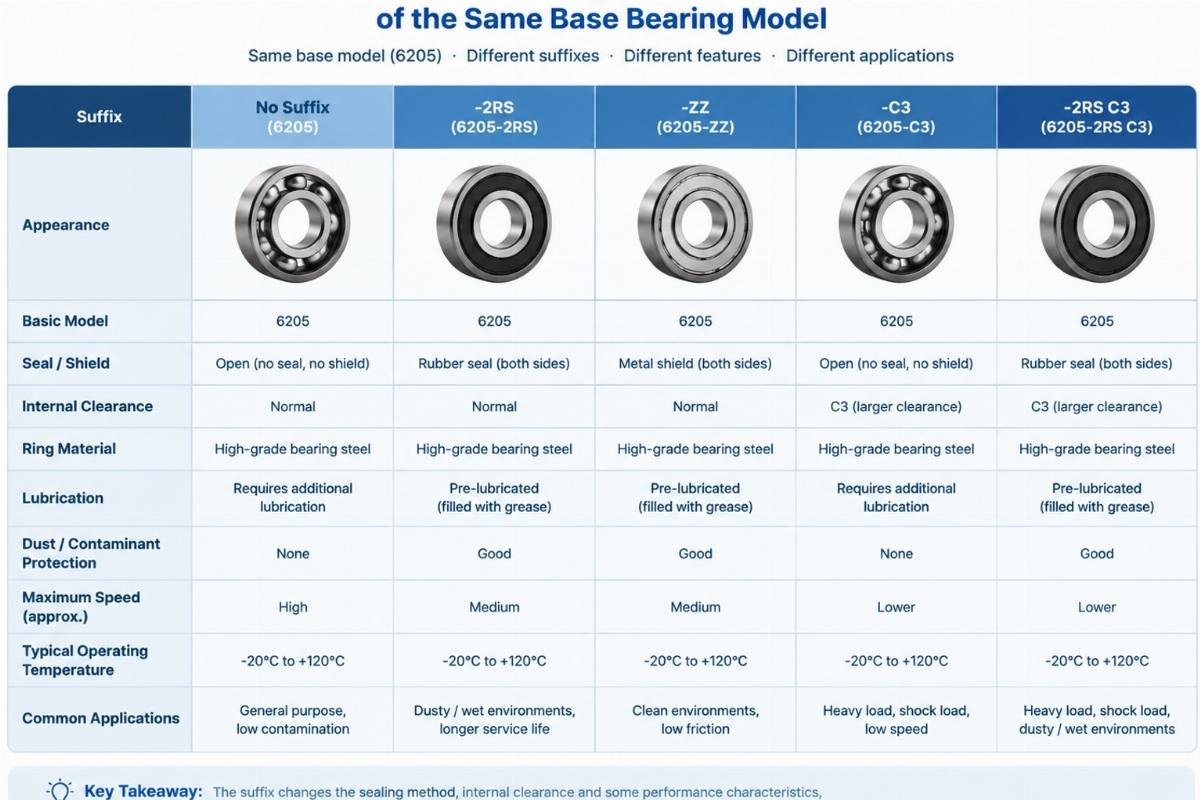
What Hidden Costs Are Buried in Your Bearing Quotes?
Unaligned Incoterms, missing traceability documentation fees, and freight traps can inflate the landed cost significantly.
A low unit price often masks additional expenses that emerge only during logistics and customs clearance. When using a bearing quotation comparison template, it is essential to include columns for Incoterms, freight costs, insurance, and documentation fees. A supplier quoting EXW (Ex Works) may appear cheaper than one quoting DDP (Delivered Duty Paid), but the buyer must account for pickup, export customs, international freight, import duties, and final delivery. For small batches, these logistics costs can exceed the value of the bearings themselves.
Furthermore, traceability documentation is not always free. Some suppliers charge extra for providing original mill certificates or EN10204 3.1 inspection certificates. For industries like mining or wind power, where failure analysis is critical, these documents are mandatory. A quote that excludes these fees may seem attractive initially but will incur unexpected costs later. [NEED_CITE: International Chamber of Commerce Incoterms rules for cost allocation]
Consider an MRO buyer who selected a supplier with a unit price ten percent lower than the market average. The quote was EXW, and the buyer did not calculate the full landed cost. After adding freight, customs brokerage, and inland transportation, the final cost was thirty percent higher than a competitor’s DDP quote. Additionally, the cheaper supplier did not include batch traceability documents, which delayed customs clearance and incurred storage fees at the port. The bearing quotation comparison template helps avoid these pitfalls by forcing a holistic view of the total acquisition cost.

How to Verify Authenticity Before Comparing Final Prices?
Demand origin certificates and batch traceability to filter out counterfeit or mixed-batch quotes.
The bearing market is plagued by counterfeits and refurbished products sold as new. A low price can sometimes indicate compromised authenticity. To protect against this, the bearing quotation comparison template should include a column for “Authenticity Verification Method.” Buyers must require suppliers to confirm the source of their stock and provide verifiable documentation.
For global brands like SKF, FAG, NSK, or TIMKEN, authenticity is tied to strict supply chain controls. A reputable supplier will provide batch numbers that can be traced back to the manufacturer’s production facilities. If a supplier cannot provide this level of traceability, the risk of receiving fake or substandard products increases significantly. [NEED_CITE: Brand-specific authentication guides and anti-counterfeit measures]
A distributor in Southeast Asia once purchased a large batch of tapered roller bearings at a discounted rate. The parts looked genuine, but upon installation, they failed prematurely. Investigation revealed that the bearings were from mixed batches with inconsistent heat treatment, likely sourced from unauthorized channels. The warranty claim was rejected because the supplier could not provide valid origin certificates. By requiring traceability documentation upfront, buyers can filter out unreliable suppliers and ensure that the quotes they compare are for genuine, reliable products.
Our approach eliminates this friction by providing complete traceability documentation for every item, regardless of brand. We consolidate mixed-brand orders, ensuring that each bearing comes with verifiable origin papers. This allows buyers to focus on technical suitability and total cost rather than worrying about authenticity.

Conclusion
True value in bearing procurement is found in technical alignment and total cost transparency, not just the lowest unit price.
A well-structured bearing quotation comparison template transforms procurement from a guessing game into a precise engineering decision. By aligning suffixes, clarifying Incoterms, and verifying authenticity, buyers can avoid hidden costs and operational failures. This method ensures that every dollar spent contributes to reliability and efficiency, protecting both the budget and the machinery.
Share this article

Written by
author
Editor covering global sourcing, supplier verification, and industrial product knowledge. Content is compiled from manufacturer specifications, industry standards, and hands-on experience with international B2B buyers. Every article is fact-checked before publishing to help procurement professionals make informed decisions.
More articles by author

