Landed Cost Calculator for Imported Bearings: Wholesale Supplier
Stop relying on FOB quotes and use a Landed Cost Calculator for Imported Bearings to reveal true warehouse-delivered expenses. Accurately account for HS code duties, freight, insurance, and port charges to avoid hidden fees. Compare suppliers based on actual total costs to protect profit margins and prevent budget overruns.
-
By author
- Updated
- 7 min read

Landed Cost Calculator for Imported Bearings: Wholesale Supplier
The invoice price is not the final cost.
The true landed cost of imported bearings includes the FOB price plus freight, insurance, import duties, port charges, and inland drayage. Calculating this total requires accurate HS code classification under Chapter 84 to determine duty rates, precise CIF valuation for tax bases, and a detailed breakdown of destination fees to avoid budget overruns and protect profit margins.
Walking the halls of the Hannover Messe years ago, I learned a hard lesson from a mentor who watched a promising deal with a German distributor nearly collapse. The FOB quote for a container of spherical roller bearings looked competitive, but the buyer’s silence after receiving the proforma invoice was telling. When we finally spoke, he revealed that his internal calculation showed the warehouse-delivered cost would be significantly higher than expected due to uncalculated anti-dumping duties and local port surcharges. That moment shifted my approach entirely. I stopped quoting just unit prices and started providing transparent breakdowns that accounted for every logistical and compliance fee. This transparency builds trust because buyers know that hidden fees are the real margin killers in cross-border procurement. [NEED_CITE: common hidden costs in international bearing imports]
Understanding these components is critical for any global bearing distributor or MRO buyer. A Landed Cost Calculator for Imported Bearings is not just a spreadsheet; it is a strategic tool that reveals the true financial impact of sourcing decisions. By systematically accounting for each element, you can compare suppliers based on actual delivered value rather than misleading headline prices.
What Exactly Makes Up the Landed Cost of Bearings?
Landed cost extends far beyond the commercial invoice, encompassing all logistics, compliance, and handling fees required to move goods from the factory floor to your warehouse.
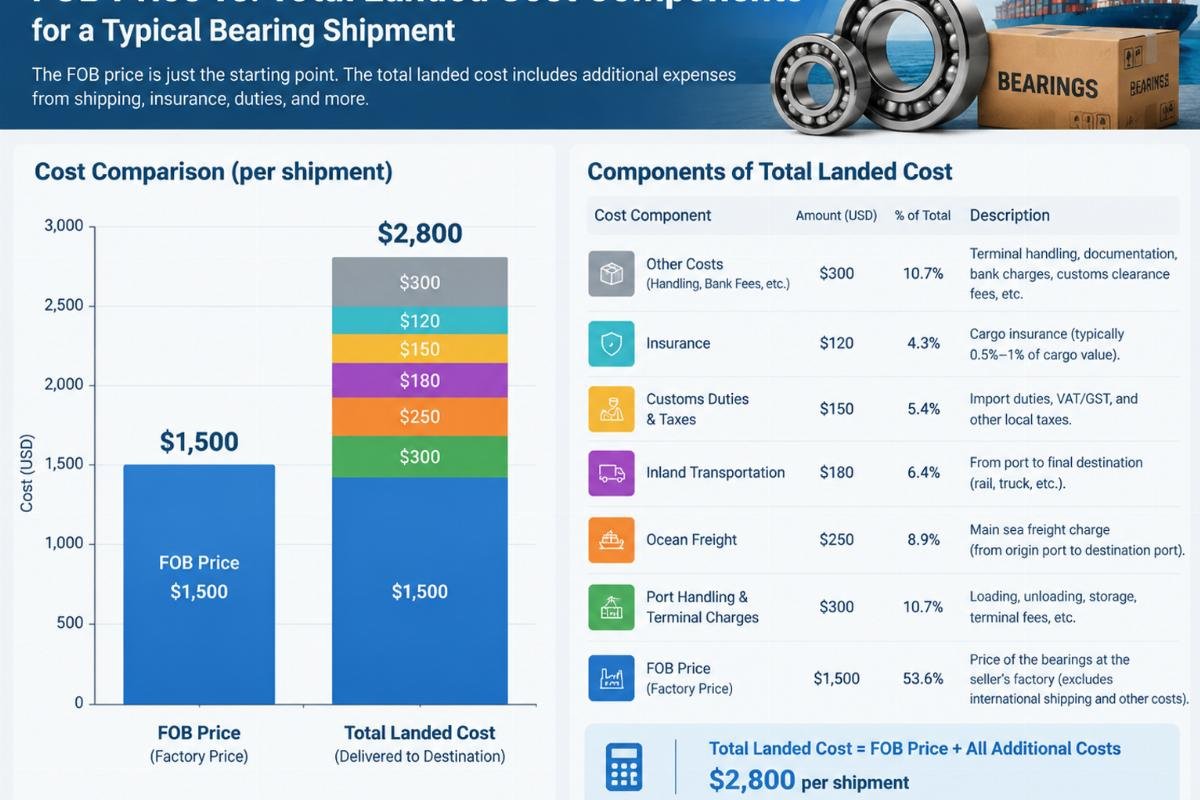
Many procurement professionals mistakenly equate the Free on Board (FOB) price with the total acquisition cost. This oversight ignores the substantial expenses incurred during transit and customs clearance. For industrial bearings, which are often heavy and dense, freight costs can represent a significant portion of the total spend. Additionally, insurance is not optional for high-value precision components; it protects against loss or damage during ocean or air transit.
Port charges at the destination are another frequent source of budget variance. These include terminal handling charges, documentation fees, and customs brokerage fees. Inland drayage, the cost of moving containers from the port to the final destination, varies widely depending on distance and fuel surcharges. Ignoring these elements leads to inaccurate profitability analysis. A comprehensive Landed Cost Calculator for Imported Bearings must include line items for each of these variables to provide a realistic view of total expenditure. [NEED_CITE: breakdown of international shipping and port fees]
Consider a scenario where a distributor imports mixed-brand bearings. The FOB price might appear low, but if the shipment requires less-than-container-load (LCL) consolidation, the per-unit freight and handling costs rise sharply compared to full container loads (FCL). Furthermore, miscellaneous fees such as customs inspection charges or storage demurrage can accrue if documentation is incomplete. By itemizing these costs, buyers can identify areas for optimization, such as consolidating orders to achieve FCL rates or negotiating better terms with freight forwarders.
How to Determine the Correct HS Code for Your Bearings?
Accurate classification under Chapter 84 of the Harmonized System is essential to prevent overpaying duties or facing customs penalties due to misdeclaration.
The Harmonized System (HS) code determines the duty rate applied to your imports. For bearings, most fall under Chapter 84, specifically heading 8482. However, the specific subheading depends on the bearing type, such as ball bearings, roller bearings, or needle bearings. Misclassification can lead to severe consequences, including back duties, fines, and delayed shipments. For instance, confusing a tapered roller bearing with a general ball bearing could result in applying an incorrect duty rate, either overpaying or triggering an audit.
Different countries may have varying interpretations or additional national codes beyond the six-digit HS standard. It is crucial to consult the specific tariff schedule of the importing country. Some jurisdictions impose anti-dumping duties on certain bearing types from specific origins. These duties can drastically increase the landed cost, sometimes doubling the duty amount. A Landed Cost Calculator for Imported Bearings must account for these potential tariffs by allowing users to input specific duty rates based on accurate HS code classification. [NEED_CITE: WTO tariff database and HS code classification rules for bearings]
A European wind farm operator once faced unexpected costs when importing precision bearings for turbine gearboxes. The initial calculation used a standard duty rate, but the customs authority reclassified the items under a specific subheading subject to higher anti-dumping measures. The resulting cost increase threatened the project’s budget. This case highlights the importance of verifying HS codes with customs brokers or using official government databases before finalizing procurement plans. Our team assists clients in navigating these complexities by providing complete customs documentation support and ensuring that mixed-brand container loads are correctly declared to minimize clearance risks.

Step-by-Step: Calculating Freight, Insurance, and Port Charges
Precise calculation of Cost, Insurance, and Freight (CIF) values and destination fees ensures no budget overruns and accurate duty assessments.
Calculating the landed cost requires a systematic approach. First, determine the FOB value of the goods. Next, add the freight cost, which depends on the mode of transport, volume, and weight. For bearings, density is a key factor; heavy items may incur weight-based surcharges. Insurance is typically calculated as a percentage of the CIF value, covering the goods against transit risks. The CIF value then serves as the base for calculating import duties and taxes in many jurisdictions.
Port charges at the destination must be estimated based on current rates from local terminals and service providers. These include terminal handling charges, customs clearance fees, and any applicable security surcharges. Inland transportation costs should also be included, reflecting the distance from the port to the warehouse. A step-by-step method ensures that no component is overlooked. Using a standardized Landed Cost Calculator for Imported Bearings helps maintain consistency across different shipments and suppliers. [NEED_CITE: international freight forwarding association guidelines for cost calculation]
Errors often occur when buyers underestimate the impact of LCL shipments. Consolidating smaller orders from multiple suppliers can reduce unit costs, but it introduces additional handling fees and potential delays. Conversely, FCL shipments offer more predictable costs but require larger capital outlays. Balancing these factors requires careful planning. For urgent MRO requirements, air freight may be necessary, significantly increasing the freight component of the landed cost. Understanding these trade-offs allows buyers to make informed decisions that align with their operational needs and budget constraints.

How to Build Your Own Landed Cost Calculator Spreadsheet
A standardized template helps compare suppliers based on true warehouse costs, not just FOB quotes, enabling smarter procurement decisions.
Building a Landed Cost Calculator for Imported Bearings in a spreadsheet involves creating distinct sections for each cost component. Start with a section for product details, including part numbers, quantities, and unit FOB prices. Add a section for logistics, where you input freight rates, insurance percentages, and estimated port charges. Include a dedicated area for duties and taxes, allowing you to input HS codes and corresponding duty rates. Finally, add a section for inland transportation and any miscellaneous fees.
Using formulas to link these sections ensures that changes in one variable, such as freight rates, automatically update the total landed cost. This dynamic approach allows for scenario analysis, such as comparing the impact of different shipping methods or duty rates. For example, you can model the cost difference between air and sea freight for urgent orders. This visibility empowers buyers to negotiate better terms with suppliers and logistics providers.
Our experience supporting global distributors has shown that those who use detailed calculators are better equipped to manage cash flow and profitability. We facilitate this process by offering one-stop global shipping consolidation and mixed-brand container loading services. By combining orders from various premium brands like SKF, FAG, and NSK, we help clients optimize their freight costs and simplify the calculation process. Providing complete traceability documentation further ensures that customs clearance proceeds smoothly, reducing the risk of unexpected fees.

Conclusion
True procurement intelligence lies in calculating the total delivered cost, not just the unit price.
Mastering the Landed Cost Calculator for Imported Bearings transforms how you evaluate suppliers and manage budgets. By accounting for duties, freight, and port charges, you gain clarity on your actual margins. This systematic approach prevents surprises and supports sustainable growth in global trade.
Share this article

Written by
author
Editor covering global sourcing, supplier verification, and industrial product knowledge. Content is compiled from manufacturer specifications, industry standards, and hands-on experience with international B2B buyers. Every article is fact-checked before publishing to help procurement professionals make informed decisions.
More articles by author

