Large Bearing Reconditioning vs Replace: Wholesale Supplier
Master the Large Bearing Reconditioning vs Replace decision to avoid costly unplanned downtime in heavy industries. While superficial damage allows for viable refurbishment, deep spalling or cracks mandate immediate replacement to ensure operational safety. Evaluate total cost of ownership beyond initial repair bills to protect your production line from catastrophic failure risks.
-
By author
- Updated
- 8 min read

Large Bearing Reconditioning vs Replace: Wholesale Supplier
Rebuilding a large bearing is not always the cheaper option. In many cases, improper reconditioning leads to secondary damage that costs significantly more than a new unit. The decision between Large Bearing Reconditioning vs Replace depends on the severity of surface damage, the integrity of the subsurface material, and the criticality of the application, rather than just the initial purchase price. For MRO managers in heavy industries like mining and cement production, understanding this distinction is vital for minimizing unplanned downtime.
I have seen the consequences of choosing cost over quality firsthand. At a nickel processing plant in Sulawesi, Indonesia, a main ball mill bearing showed early signs of pitting. To save money, the site management opted for local reconditioning without rigorous non-destructive testing or precise clearance adjustment. The result was catastrophic: the cage fractured within two weeks, causing half a month of production stoppage. The financial loss from downtime far exceeded the cost of a genuine replacement bearing. This experience highlights why technical diligence must drive the choice in Large Bearing Reconditioning vs Replace decisions. [NEED_CITE: impact of bearing failure on industrial production downtime]
When evaluating options, it is essential to look beyond the immediate repair bill. A proper assessment involves checking for spalling depth, measuring wear patterns, and verifying the structural integrity of the rings. If the damage is superficial, reconditioning can extend service life meaningfully. However, if the subsurface material is compromised, replacement is the only viable path. This guide explores the technical and economic factors that should inform your strategy for Large Bearing Reconditioning vs Replace.
When Is Reconditioning a Viable Option?
Reconditioning is suitable only when damage is limited to the surface layer. It involves processes like polishing, grinding, and sometimes re-hardening, but it cannot restore the core structural integrity of a bearing that has suffered deep fatigue.
The primary indicator for reconditioning is shallow surface distress. If inspection reveals minor smearing, light corrosion, or shallow indentation that does not exceed specific depth thresholds, the bearing may be a candidate for refurbishment. [NEED_CITE: ISO standards for bearing damage classification and acceptance criteria] Deep spalling, however, indicates that fatigue cracks have propagated into the material. Attempting to grind away such damage often removes too much material, altering the internal geometry and load distribution.
Consider a case from a cement plant in Southeast Asia. A kiln support bearing exhibited uniform wear but no deep cracking. Through a controlled reconditioning process that included precise grinding and super-finishing, the bearing was restored to near-original specifications. The plant reported that the refurbished unit ran substantially longer than expected, providing a cost-effective solution compared to a new purchase. This success was due to strict adherence to quality controls during the rebuild.
However, the risk lies in the quality of the reconditioning service. Not all workshops have the capability to perform micron-level precision work. Poorly executed reconditioning can introduce new stress concentrators, leading to premature failure. Therefore, the decision in Large Bearing Reconditioning vs Replace scenarios must include an audit of the service provider’s technical capabilities.

Key factors for viable reconditioning include:
- Surface-only damage: No subsurface cracks or deep spalling.
- Geometric integrity: Rings are not distorted or out-of-round beyond corrective limits.
- Material hardness: The core hardness remains within the standard range for bearing steel. [NEED_CITE: typical hardness range for bearing steel components]
If any of these conditions are not met, reconditioning is likely to fail. In such cases, replacement becomes the necessary choice to ensure reliability.
The Hidden Costs of Poor Reconditioning
Choosing the lowest bid for reconditioning often results in higher total costs. The initial savings are frequently erased by early failure, additional downtime, and collateral damage to surrounding components.
A common misconception is that reconditioning is always cheaper. While the upfront cost is lower, the lifecycle cost can be higher if the process is flawed. For instance, skipping non-destructive testing (NDT) might miss hidden cracks. When the bearing is put back into service, these cracks propagate rapidly under load, causing sudden failure.
In the Sulawesi incident mentioned earlier, the lack of proper NDT was the critical error. The local workshop polished the surface but did not detect the underlying fatigue. The resulting fracture damaged the housing and required extensive repairs to the mill itself. The total cost, including lost production, was several times the price of a new bearing. This illustrates why the choice in Large Bearing Reconditioning vs Replace must account for risk, not just repair fees.
Another hidden cost is the loss of precision. Large bearings operate with tight clearances. If reconditioning alters the internal geometry even slightly, it can lead to uneven load distribution. This causes increased vibration and heat generation, accelerating wear on both the bearing and the shaft. Over time, this reduces the overall efficiency of the machinery.
To avoid these pitfalls, it is crucial to verify the reconditioning provider’s process. Do they perform magnetic particle inspection? Do they measure roundness and cylindricity after grinding? Are the final clearances checked against original specifications? Without these checks, the risk of failure remains high.
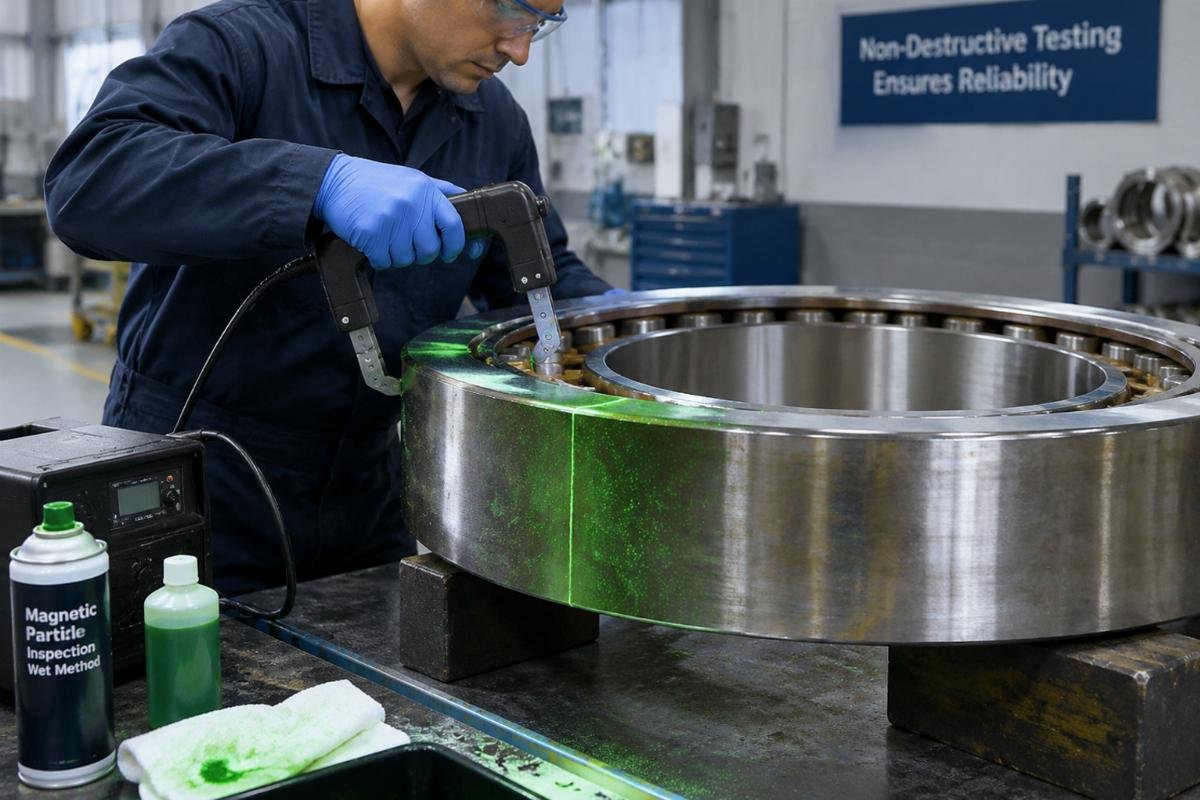
Risk factors in low-cost reconditioning include:
- Incomplete NDT: Failure to detect subsurface cracks or material defects.
- Poor geometric control: Deviations in roundness or parallelism leading to uneven loading.
- Incorrect clearance adjustment: Resulting in excessive heat or premature wear.
When these risks are present, the argument for replacement becomes stronger. A new bearing comes with guaranteed specifications and traceability, reducing the uncertainty associated with refurbished units.
Critical Thresholds for Mandatory Replacement
Some damage types make replacement the only safe option. Recognizing these thresholds prevents costly mistakes and ensures operational safety.
Deep spalling is the most common reason for mandatory replacement. When flakes of metal break away from the raceway or rolling elements, it indicates advanced fatigue. The depth of these pits often exceeds the amount of material that can be safely removed during reconditioning. Grinding away deep spalls would compromise the structural strength of the ring, making it prone to catastrophic failure.
Cracked rings or cages are another absolute indicator for replacement. Cracks cannot be repaired reliably in high-load applications. Any attempt to weld or fill cracks introduces residual stresses and material inconsistencies that weaken the component. In heavy industries like mining, where loads are extreme and continuous, a cracked bearing poses a significant safety hazard.
Severe corrosion is also a deal-breaker. If corrosion has pitted the surface deeply or compromised the material structure, reconditioning cannot restore the original performance. The remaining material may have reduced fatigue resistance, leading to unpredictable failure modes.
A crusher operator in Africa faced this issue when a main bearing showed severe spalling on the outer ring. Despite the high cost of a new unit, replacement was the only option. Attempting to recondition it would have been futile and dangerous. The new bearing, sourced with full traceability, restored the crusher’s performance and prevented further damage to the shaft.

Indicators for mandatory replacement include:
- Deep spalling: Pits that exceed safe grinding limits.
- Cracks: Any visible cracks in rings, cages, or rolling elements.
- Severe corrosion: Deep pitting or material loss due to chemical attack.
- Overheating damage: Discoloration or softening of the material due to excessive heat.
In these scenarios, the debate over Large Bearing Reconditioning vs Replace ends clearly. Replacement is the only responsible choice.
Evaluating Total Cost of Ownership
The true cost of a bearing includes more than just the purchase price. Downtime, labor, and risk of secondary damage must be factored into the decision.
For MRO managers, minimizing unplanned downtime is a top priority. A failed bearing can stop an entire production line, leading to significant revenue loss. Therefore, the reliability of the solution is paramount. A new bearing offers predictable performance and a known lifespan. A reconditioned bearing, unless done to the highest standards, carries uncertainty.
When comparing Large Bearing Reconditioning vs Replace, consider the cost of downtime. If a reconditioned bearing fails prematurely, the cost of stopping production again, plus the labor for removal and installation, can outweigh the initial savings. In contrast, a new bearing provides peace of mind and a warranty, reducing financial risk.
Labor costs are another factor. Installing a large bearing is a complex task requiring specialized tools and skilled personnel. Doing this twice—once for a failed reconditioned unit and again for a new one—doubles the labor expense. It is often more efficient to install a new unit correctly the first time.
Furthermore, the availability of spare parts plays a role. Keeping a stock of new bearings for critical applications ensures quick replacement in case of emergency. Relying on reconditioning services can lead to delays if the workshop is busy or if the damage is worse than initially assessed.

Factors in total cost of ownership include:
- Downtime cost: Revenue lost during production stoppages.
- Labor expense: Cost of skilled technicians for installation and removal.
- Secondary damage: Potential repair costs for shafts, housings, or other components.
- Warranty and support: Availability of technical assistance and guarantees.
By looking at the big picture, managers can make informed decisions that optimize both budget and reliability. In many critical applications, the stability of a new bearing justifies the higher initial investment.
Conclusion
The choice between reconditioning and replacement is not binary but contextual. It requires a careful assessment of damage, risk, and total cost.
For superficial damage, high-quality reconditioning can be a cost-effective solution. However, for deep spalling, cracks, or critical applications, replacement is the only safe and reliable option. The lesson from the field is clear: do not let short-term savings compromise long-term operational integrity.
When navigating Large Bearing Reconditioning vs Replace decisions, prioritize technical verification and risk management. Ensure that any reconditioning work meets strict quality standards, and do not hesitate to replace when damage exceeds safe limits. This approach minimizes downtime and protects your investment in heavy machinery.
Tags
Share this article

Written by
author
Editor covering global sourcing, supplier verification, and industrial product knowledge. Content is compiled from manufacturer specifications, industry standards, and hands-on experience with international B2B buyers. Every article is fact-checked before publishing to help procurement professionals make informed decisions.
More articles by author

